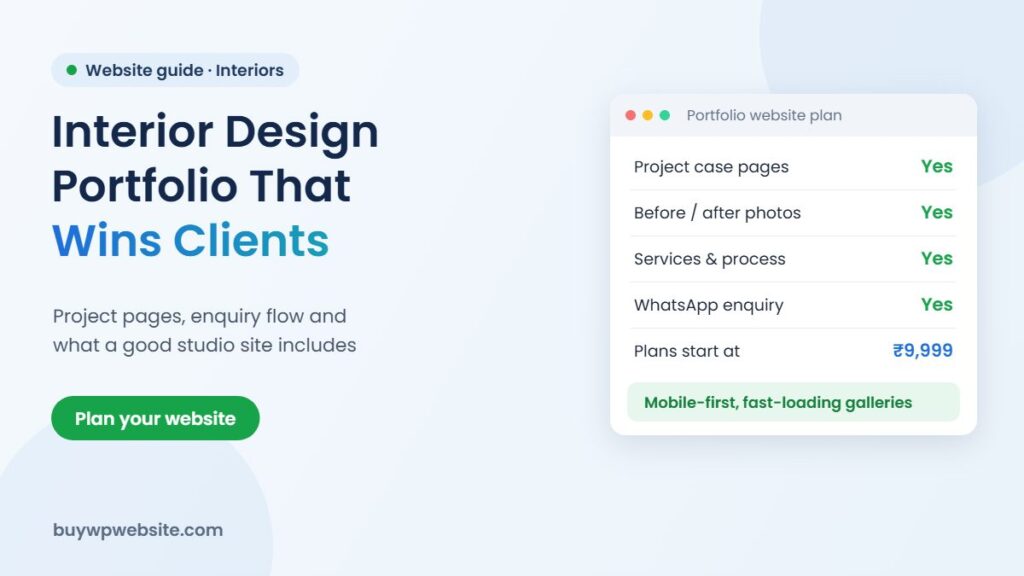
Quick answer: A good website for interior design company owners is a portfolio first and a brochure second. Show 6 to 12 of your best projects as full case pages with before and after photos, the brief and the budget range, then make it easy to book a site visit on WhatsApp or through a short form. In India, a professionally designed portfolio site with these features starts at ₹9,999 + GST.
Homeowners and office managers rarely hire an interior designer from a visiting card. They look you up on Google and Instagram, then compare your work with two or three other studios. Your website is the place where that comparison is won or lost.
Why an interior designer needs more than Instagram
Instagram is great for reach, but a feed mixes finished projects with mood boards, reels and festival greetings. A client planning a ₹15 lakh home interior wants to see complete projects, read how you work and check that you are an established business. A website gives you:
- A permanent, organised portfolio that you control, not an algorithm.
- A chance to rank on Google for searches like “interior designer in Jaipur” or “modular kitchen designer near me”.
- A professional link to send with every quotation, so the client can show your work to family or partners.
- Enquiries that come with details (property type, size, city, budget) instead of a one-line “price?” DM.
Pages every website for interior design company needs
| Page | What goes on it | Why it matters |
|---|---|---|
| Home | One strong hero photo, your style in one line, 3 to 6 featured projects, a clear “Book a consultation” button | Visitors decide in seconds whether your style matches theirs |
| Projects | Grid of project cards filtered by type: homes, kitchens, offices, retail, hospitality | Lets a café owner skip straight to commercial work |
| Project detail pages | Brief, area, duration, budget band, photos, materials, client quote | This is where trust is built |
| Services | Full home interiors, modular kitchens, turnkey execution, design-only consultation | Clarifies what you do and do not take on |
| Process | Site visit, concept, 3D views, approvals, execution, handover | Reduces fear of delays and hidden costs |
| About | Founder story, team photos, studio address, years in practice | Clients want to know who will be in their home |
| Contact | Short form, WhatsApp button, Google Map, working hours | Makes the next step obvious |
For a deeper look at how many pages a small business site really needs, see our guide to essential small business website pages.
How to structure a project page that wins clients
Most studio websites show a gallery of pretty photos with no story. That makes every studio look the same. Turn each project into a short case study instead.
Start with the brief
Two or three sentences: “A 3BHK in Mansarovar for a young family who wanted more storage and a brighter living room.” The reader instantly sees whether their situation is similar.
Show the before, during and after
Before photos prove the transformation is real. A few on-site shots during execution show that you manage work, not just drawings. If you used 3D renders, place one next to the final photo to show how closely you deliver what you promise.
Give the facts
Carpet area, timeline and a budget band such as “₹8 to 12 lakh” help clients self-qualify. Use your own real numbers only. If a client prefers privacy, leave the budget out rather than estimate it.
Close with the client’s words
Ask happy clients for a two-line review and permission to use their first name and area. Real testimonials, even short ones, beat polished but generic praise. Link to your Google reviews as well.
Photos: the make-or-break detail
- Hire a photographer for your best three projects. Wide-angle, well-lit photos are worth more than any design trick on the website.
- Shoot in daylight and declutter. Remove personal items, straighten cushions, switch on warm lights for depth.
- Compress every image. Large photos are the main reason portfolio sites load slowly on phones. Use WebP where possible and keep each image to a few hundred KB.
- Write alt text like “modular L-shaped kitchen with white quartz counter” to help Google Images send you visitors.
- Ask clients before publishing photos of their home, and avoid showing house numbers or family photos.
Turning visitors into consultation bookings
An interior project is a big decision, so the first step should feel small. Offer a site visit or a 30-minute studio consultation rather than asking people to “get a quote”. Keep the form short: name, phone, city, property type and approximate area. A WhatsApp button that opens a pre-filled message works well for mobile visitors.
Add local SEO basics too: your studio address on every page footer, a Google Map on the contact page, a Google Business Profile with the same name and phone, and service pages that mention the areas you actually work in. Writing a blog post now and then (kitchen layout ideas, how long a 2BHK interior takes) gives Google more reasons to show your site.
How much does an interior designer website cost?
Costs depend on the number of pages and whether you need custom features like 3D walkthrough embeds or a cost calculator. A managed portfolio website plan is usually enough for a new or mid-sized studio; a fully custom design suits large firms with specific branding. Our detailed website cost in India guide compares the options.
How BuyWPWebsite helps interior designers
Our portfolio website design service is built for exactly this: project galleries, service pages, a blog, WhatsApp chat, contact forms with reCAPTCHA, Google Maps and on-page SEO. Plans start at ₹9,999 + GST for up to 5 pages; Standard (15 pages) and Premium (40 pages) suit studios with many projects to show. Hosting for the first year and free maintenance are included, and our team uploads new projects for you during that period. If you need a fully bespoke design, Webuncles also offers custom web design.
Frequently asked questions
How many projects should I show on my website?
Quality beats quantity. Six to twelve well-photographed projects with proper case pages work better than fifty random photos. Add new ones as you finish them and remove older work that no longer reflects your style.
Should I display prices on an interior design website?
Exact prices are hard because every site is different, but budget bands on project pages and a starting price for design-only consultations help filter out mismatched enquiries.
Can I use 3D renders instead of real photos?
Use renders for ongoing projects and clearly label them as concepts. Clients trust finished photos more, so replace renders with real photos once a project is complete.
Who updates the portfolio after the website is live?
With BuyWPWebsite, you send us photos and project details and our team adds them, free during your plan’s maintenance period. Later changes are billed at ₹1,000 per hour.