
Quick answer: Under the doctor website NMC guidelines in force as of November 2026, your website and Google profile can show factual details: your name, recognised qualifications, registration number, specialty, clinic address, timings, services and charges. You cannot use patient testimonials, paid or fake reviews, “best doctor” style claims, promotional before-and-after photos, discount offers or unlabelled AI content. The rules come from NMC’s ethical advertising guidelines dated 6 October 2026, read with the 2002 ethics regulations.
What are the NMC rules for doctor websites in 2026?
On 6 October 2026, the National Medical Commission issued the Guidelines on Ethical Advertising and Public Communication for registered medical practitioners (RMPs) and hospitals. The notice says they apply with immediate effect. They cover websites, social media, search results, healthcare platforms, messaging apps, podcasts, influencer campaigns and AI-generated content.
These guidelines sit on top of the Indian Medical Council (Professional Conduct, Etiquette and Ethics) Regulations, 2002. Those older regulations are still the main conduct code for doctors. The newer RMP (Professional Conduct) Regulations, 2023 were put on hold by NMC on 23 August 2023, and we found no later notification bringing them back as of November 2026.
Hospitals and clinics are also covered by the Clinical Establishments Act, 2010 or their state’s equivalent law. If you run a nursing home or multi-doctor clinic, check your state rules as well.
Can doctors advertise in India?
Not in the commercial sense. Soliciting patients, directly or indirectly, has been treated as unethical since the 2002 regulations, and the 2026 guidelines repeat this for the digital world. Campaigns that create unnecessary demand for procedures, or that make medical practice look commercial, are not allowed.
What is allowed is giving patients factual information so they can find and contact you. A clinic website that tells people who you are, what you treat, where you sit and when you are available is a patient-information tool, not an advertisement. Health awareness and educational content is also fine, as long as it does not push your own practice or ask people to book.
Breaking the rules has consequences. The guidelines set graded action by the State Medical Council: a warning and ethics training for a first violation, censure and a monetary penalty for a second, and suspension of registration for a third or a serious violation. Repeated violations can lead to removal from the register for one to three years. A show-cause notice comes first, and appeals go to NMC’s Ethics and Medical Registration Board.
What your clinic website can show
Keep everything factual and verifiable. These items are supported by the 2026 guidelines or the 2002 regulations:
- Your name with only recognised medical degrees and diplomas after it.
- Your registration status and State Medical Register or National Medical Register number. The 2026 guidelines require this on electronic media posts by doctors.
- Your specialty, the conditions you treat and the services the clinic offers, described plainly.
- Clinic name, address, map, phone number and consultation timings.
- Consultation fees and charges. The 2002 regulations ask doctors to display fees, and the 2026 guidelines allow a public declaration of charges.
- Facilities, equipment, departments, emergency services and accreditation, stated as facts without “most advanced” style claims.
- Formal notices when you start or resume practice, move to a new address or will be away for a while.
- For hospitals, a doctor directory with names, qualifications, specialties, registration details and availability.
- General health education articles that do not ask readers to book with you.
If you are planning pages for a new site, our doctor website design guide walks through the full page list, and this post on how many pages a website needs helps you decide between 5 and 15 pages.
What a doctor website must not show
Most existing clinic websites and Instagram pages need changes here. The 2026 guidelines prohibit:
- Patient testimonials, reviews and endorsements used to promote you. Written patient consent does not change this.
- Fake, paid or manipulated reviews and ratings, bought followers, likes or comments.
- Claims like “100% success”, “painless treatment” or “guaranteed cure”. Comparative words such as “best”, “No.1” or “most trusted” are also barred unless they can be objectively and independently verified.
- Success rates, number of patients treated and unverifiable awards or rankings.
- Promotional before-and-after photos, surgical results and celebrity patients. Anonymised use with consent is allowed only for scientific or educational purposes.
- Discounts, limited-period offers, coupons, cashback, referral benefits or free procedures that could push people towards unnecessary care.
- Endorsing any drug, device or health product.
- Using influencers, celebrities, staff or patients to promote your services. Hiring an agency does not move the responsibility away from you.
- Identifiable patient data such as names, faces or case details shared publicly.
A plain test helps: if a line tries to persuade rather than inform, remove it or rewrite it as a fact.
Doctor website NMC guidelines checklist
Go through your website, Google profile and social pages with this table.
| Item | Status | What to do |
|---|---|---|
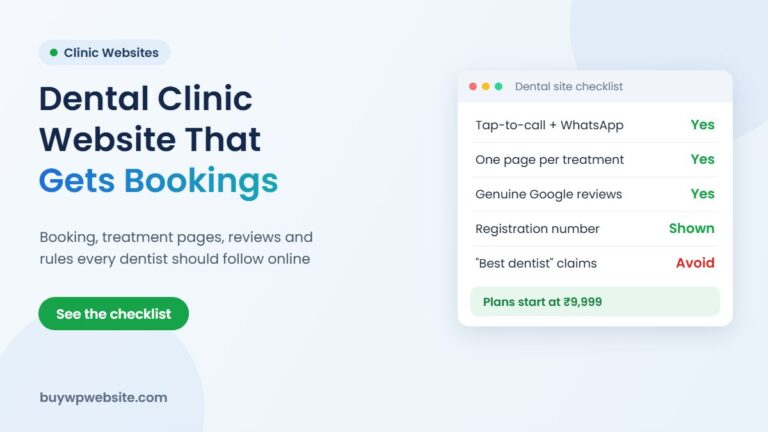
| Name, recognised degrees, specialty | Allowed | Show clearly on home and About pages |
| SMC/NMR registration number | Allowed (required on posts) | Add to footer, doctor profile and social bios |
| Address, timings, phone, map | Allowed | Keep the same on website and Google profile |
| Consultation fees and charges | Allowed | State them plainly, no “offer” wording |
| Services and conditions treated | Allowed | Describe factually, no outcome promises |
| Patient testimonials and video reviews | Not allowed | Remove from website and social media |
| “Best”, “No.1”, “100% success” claims | Not allowed | Replace with qualifications and experience facts |
| Discount coupons, free procedure offers | Not allowed | Remove promotional offers |
| Paid or fake Google reviews | Not allowed | Never buy reviews or use review agencies |
| Your own photo on the website | Check first | Avoid promotional use; ask your council |
| Before-and-after images | Check first | Only anonymised, consented, for education |
| AI-written or AI-generated content | Check first | Label it as AI-generated, never fake patients |
| Awards and rankings | Check first | Show only if verifiable, with awarding body and date |
This post is general information, not legal advice. Confirm anything you are unsure about with NMC or your State Medical Council before you publish.
Google profile, reviews, AI and patient photos
Google Business Profile
The guidelines do not name Google, but they cover search results, online ratings and reviews. A Google profile with your clinic name, address, timings, phone and services is factual information and fits within the rules. Use the same details as your website and add your registration number in the description where it fits.
Reviews are the risky part. The guidelines bar requesting patient reviews for promotion on social media, and buying or manipulating reviews anywhere. They do not mention reception cards or WhatsApp review links, so the cautious approach is to avoid both. If an unhappy patient leaves a review, reply politely without sharing any medical details.
AI-generated content
AI-generated promotional campaigns for commercial gain are prohibited. Other AI content that follows the rules is allowed, but it must carry a clear mark that it came from AI. AI must never be used to create patient images, voices, testimonials or outcomes. If an agency writes your blog with AI, ask them to fact-check it and label it.
Your photo and patient images
The 2002 regulations treat a self-photograph on a letterhead or signboard as self-advertisement, and the 2026 guidelines extend this to photos used for promotional publicity. A simple profile photo on a doctor directory page is common, but the line is not spelled out, so ask your State Medical Council if you want to use it prominently. Patient photos need specific, documented consent and must hide identifying features.
For ethical ways to be found on Google without promotion, read this guide on healthcare SEO for clinics. It also helps to know what a website costs in India before you decide between fixing an old site and building a new one.
How BuyWPWebsite can help
Our medical website design plans are built around factual pages: doctor profile with qualifications and registration number, services, timings, fees, location map and a contact or WhatsApp button. No testimonial sliders, no “best doctor” banners.
A single-doctor clinic usually fits the Basic plan at ₹9,999 + GST (5 pages, about 4 working days). A multi-doctor clinic or diagnostic centre with separate service pages fits the Standard plan at ₹14,999 + GST (15 pages, about 7 working days). Design, hosting, domain, SSL and maintenance come together in one annual plan, and changes are free during the maintenance period.
Send your clinic website or Google profile on WhatsApp and we will point out what to change. For a new site, you can order a ₹999 + GST design preview from the medical website plan page before you commit. Final content is your call; we build to the brief you approve.
Frequently asked questions
Can doctors advertise on social media in India?
Doctors can share health awareness and educational content, but cannot use social media to solicit patients or promote their practice. Under the October 2026 NMC guidelines, every electronic media post must disclose your name, qualifications, registration status and registration number.
Can a doctor show patient testimonials on a website?
No. The 2026 guidelines prohibit requesting or sharing patient testimonials, reviews or endorsements for promotion. Written consent from the patient does not change this.
Is it mandatory to display the registration number on a doctor website?
The 2002 regulations require doctors to display their registration number, and the 2026 guidelines require it on electronic media posts. Showing it on your website footer and doctor profile is the safe approach.
Can doctors ask patients for Google reviews?
Requesting reviews for promotional purposes is prohibited, and buying or manipulating reviews is clearly not allowed. Let patients review on their own and respond politely without sharing medical details.
Are the NMC Professional Conduct Regulations 2023 in force?
No. NMC put them in abeyance on 23 August 2023, and the 2002 regulations continue to apply. Check the NMC website for any later notification.
What is the penalty for breaking NMC advertising guidelines?
Your State Medical Council acts after a show-cause notice. Action ranges from a warning and ethics training to a monetary penalty, suspension and, for repeated violations, removal from the register for one to three years.