Quick answer: What is domain and hosting? Your domain is your website’s address (like yourshop.in), hosting is the computer space where your website’s files live, and SSL is the security certificate that puts the padlock and “https” in front of your address. You need all three for a business website. The most important rule: register the domain in your own business name, with your own email, so you always control it.
What is domain and hosting, in plain English?
Think of your website as a shop.
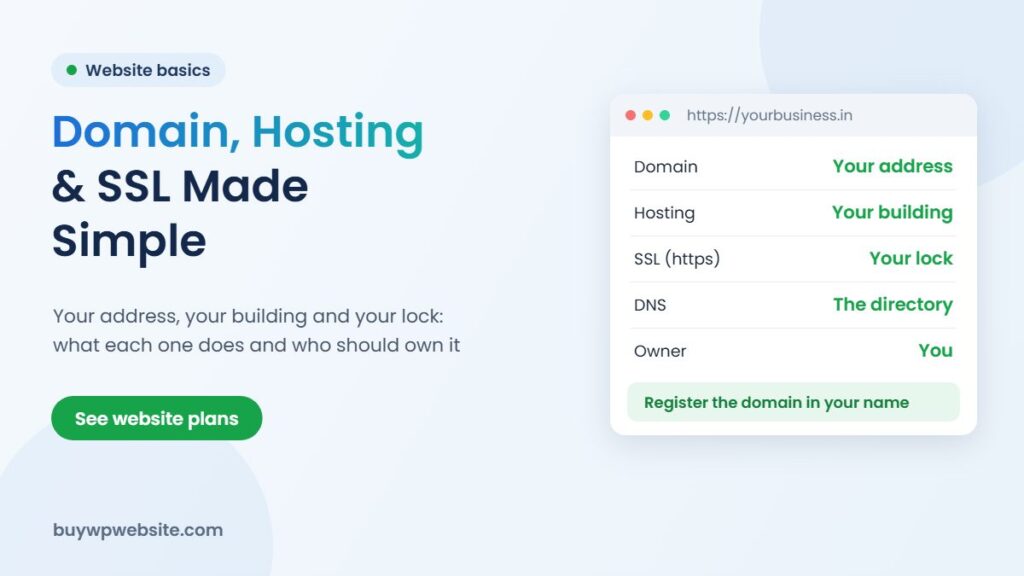
| Website part | Shop comparison | What it does |
|---|---|---|
| Domain name | The shop’s address and signboard | Tells people and browsers where to find you |
| Hosting | The rented building | Stores the website files and serves them to visitors |
| SSL certificate | The lock on the door | Encrypts data between the visitor and your site |
| DNS | The directory that links address to building | Points your domain to your hosting |
| Website (WordPress) | The interiors and stock | The pages, photos and forms people see |
If any one of these is missing or expires, the website stops working or shows a warning. That is why it pays to understand who holds each one.
Domain names: choosing and owning yours
A domain is rented year by year from a registrar, an accredited company that sells domains. You can register for one year or several at a time, and you must renew before it expires.
.in, .co.in or .com?
For a business that sells mainly in India, a .in domain is a natural choice and signals you are Indian. The .in registry is run by NIXI under the Government of India. A .com works everywhere and is better if you also target overseas buyers. If both are available for your name, many businesses buy both and point one to the other.
Tips for a good business domain
- Short, easy to spell when said aloud on a phone call.
- Avoid hyphens and numbers that people mix up.
- Use your brand name; add the city or trade only if the plain name is taken (for example, sharmasweetsjaipur.in).
- Check that the name does not copy another company’s trademark.
Register it in your own name
This is a very common problem: a business owner’s domain was bought years ago by a cousin, an old employee or a freelancer, and nobody can log in to renew or move it. Avoid it by making sure the registrant name is your business, the account email is one you control, and the login details are stored safely by you. Your website designer can be given access to manage DNS, but ownership should stay with you.
Hosting: what kind does a small business need?
Hosting is measured mainly by how many visitors and how much processing your site can handle smoothly.
| Hosting type | Good for | Trade-off |
|---|---|---|
| Shared hosting | Business, clinic and portfolio websites with normal traffic | Resources are shared with other sites on the server |
| Managed WordPress hosting | Owners who want updates, backups and security handled | Costs more than basic shared hosting |
| VPS or cloud server | Online stores with many products or high traffic | Needs technical management |
For most small business websites, good shared or managed hosting is enough. What matters more than the label is speed, daily or regular backups, uptime and support that answers when something goes wrong.
SSL certificates and the padlock
An SSL certificate encrypts the connection between a visitor’s browser and your website. With it, your address starts with https and browsers show a padlock. Without it, Chrome and other browsers label the site “Not secure”, which scares customers away from contact forms and payments.
- Free SSL (such as Let’s Encrypt) is perfectly fine for business websites and most stores.
- Paid SSL with organisation validation is used by larger companies that want their verified name in the certificate.
- SSL certificates renew automatically on most hosts; an expired certificate shows a full-page warning.
Business email on your domain
An email address ending in your own domain looks far more professional on visiting cards and quotes than a free webmail address. It is set up through your domain’s DNS, using either your hosting’s email or a separate service such as Google Workspace or Zoho Mail. Separate services usually give better delivery and storage, and keep email working even if you change your website host.
Common mistakes business owners make
- Letting someone else hold the domain. If the person leaves or stops responding, recovering the domain can take weeks of paperwork.
- Using an old personal email for the registrar account. Renewal reminders go to an inbox nobody checks, and the domain lapses quietly.
- Choosing the cheapest hosting on price alone. A slow site loses visitors on mobile data, and poor support costs more in lost enquiries than the savings.
- Ignoring the “Not secure” label. Many visitors will not fill a form on a site without https.
- Changing DNS without a plan. Moving hosting or email without copying the existing DNS records can break email for days.
A simple ownership checklist
- Domain registered in your business name, with your email.
- Domain auto-renew switched on, with a working payment method.
- You know who your hosting provider is and when the hosting renews.
- SSL is active and the site opens with https.
- Backups exist, and you know who can restore them.
For a fuller picture of what a site costs in total, read our guide on website cost in India, and if you are deciding between hiring someone and doing it yourself, see website designer vs website builder.
What our website plans include
Our business website plans, starting at ₹9,999, include the first year of hosting on shared servers sized for small-business traffic, SSL so your site opens with https, and backups. If you already own a domain, tell us when you order and we connect it to the new site; if you do not have one yet, we recommend registering it in your business’s own name. Our team manages updates and content changes during the maintenance period, so you do not have to touch hosting panels. Need a larger or custom build? Webuncles handles custom website development, and you can read about custom WordPress design on jvyas.com.
Frequently asked questions
Can I buy a domain without hosting?
Yes. Many businesses register the domain first to secure the name, and connect hosting later when the website is ready.
What happens if my domain expires?
Your website and domain email stop working. Registrars usually give a short grace period to renew, but after that the name can be released and bought by someone else.
Is free SSL safe for a business website?
Yes. Free certificates use the same encryption as paid ones. Paid certificates mainly add organisation verification and support.
Can I move my domain to another provider later?
Yes, if it is in your name. You unlock the domain, get a transfer code from the current registrar and start the transfer at the new one. This is why ownership matters.
Facts checked in November 2026.