
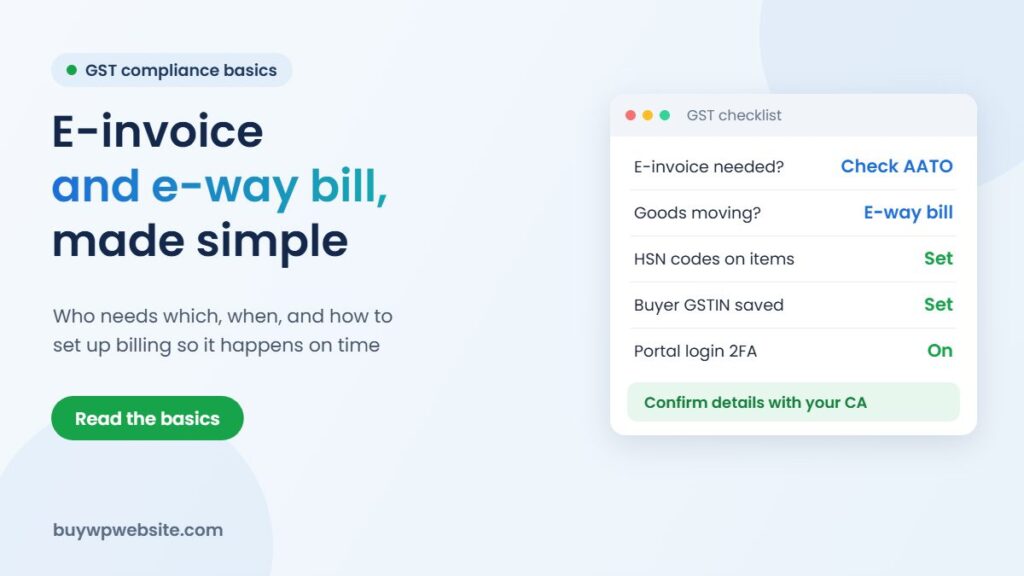
Quick answer: E-invoice and e-way bill are two different GST requirements. An e-invoice is needed for B2B invoices once your aggregate annual turnover (AATO) has crossed ₹5 crore in any financial year from 2017-18 onwards; it gets an IRN and QR code from the Invoice Registration Portal. An e-way bill is needed to move goods, generally when a consignment is worth more than ₹50,000, whatever your turnover. Many small units need e-way bills long before they need e-invoices.
This is a plain-language overview for owners of small manufacturing and craft units, written as part of our ODOP scheme series. GST rules are updated often, so treat it as a starting point and confirm your own position with your CA or tax practitioner.
E-invoice and e-way bill: what is the difference?
| Point | E-invoice | E-way bill |
|---|---|---|
| Purpose | Reporting a B2B invoice to the GST system | Documenting the movement of goods |
| Who needs it | Registered taxpayers whose AATO crossed ₹5 crore in any year since 2017-18 | Anyone causing movement of goods above the value limit, regardless of turnover |
| Covers | B2B invoices, credit and debit notes, exports | Sales, stock transfers, job work, returns and other movements |
| Portal | Invoice Registration Portal (IRP), e.g. einvoice1.gst.gov.in | ewaybillgst.gov.in |
| Output | IRN (Invoice Reference Number) and signed QR code | E-way bill number (EBN) |
Does your unit need e-invoicing yet?
The current threshold is an aggregate annual turnover above ₹5 crore, applicable from 1 August 2023. The test looks at any financial year from 2017-18 onwards, and AATO is counted on your PAN across all GSTINs. Two consequences surprise owners:
- Once you cross the limit in one year, you stay covered even if turnover drops later.
- The requirement applies to B2B invoices and exports. Sales to ordinary consumers (B2C) do not need an IRN at this turnover level.
The 30-day reporting window
From 1 April 2025, taxpayers with AATO of ₹10 crore or more cannot report an invoice or credit/debit note to the IRP if it is more than 30 days old. Smaller e-invoicing units are not yet blocked this way, but reporting the same day is the safest habit.
What happens if you skip it
A B2B invoice that should carry an IRN but does not is not treated as a valid tax invoice, which can block your buyer’s input tax credit and invite penalties. Buyers, especially larger companies, will often refuse to pay against it.
When an e-way bill is required
For inter-state movement, an e-way bill is generally needed when the consignment value (including GST) exceeds ₹50,000. A few cases matter specially for ODOP units:
- Job work across states: goods sent by a principal to a job worker in another state need an e-way bill irrespective of value.
- Handicraft goods: inter-state movement of handicraft goods by a person exempt from registration also needs an e-way bill even below ₹50,000 – relevant for artisans travelling to fairs.
- Movement within Rajasthan: states set their own intra-state limits. Rajasthan notified a limit of ₹1 lakh for most goods from April 2021, with exceptions for some items; check the current state-wise list on the e-way bill portal before relying on it.
How an e-way bill is generated, step by step
- Part A – invoice or challan number and date, GSTIN of supplier and recipient, delivery PIN code, HSN code, value and reason for transport. If you issue e-invoices, Part A can be filled automatically from the IRN data.
- Part B – vehicle number or the transporter’s document. If the goods go from your place of business to a transporter within the same state and the distance is up to 50 km, Part B can be filled later by the transporter.
- Hand over the EBN to the driver (printed or on phone) along with the invoice or delivery challan.
Validity, extensions and recent rule changes
- Validity for normal cargo: one day for up to 200 km, plus one more day for every additional 200 km or part of it. Over-dimensional cargo has a shorter per-day distance.
- Old documents: since 1 January 2025, an e-way bill can only be generated against an invoice or challan that is not more than 180 days old.
- Extensions: also since 1 January 2025, the total validity, including extensions, cannot go beyond 360 days from the original generation date.
- Login security: two-factor authentication became mandatory for the e-way bill and e-invoice portals from 1 April 2025, so keep the registered mobile number with someone who is actually in the office.
Setting up your billing so compliance is automatic
Typing invoice data twice – once in your billing software and again on the government portal – is where most errors creep in. Accounting and ERP software that connects to the IRP and e-way bill system (directly or through a GST Suvidha Provider) can generate the IRN and e-way bill from the invoice itself. Before you switch it on:
- Check every item has the right HSN code and GST rate.
- Save customer GSTINs and PIN codes in the customer master.
- Agree a cut-off time each day by which invoices are reported.
- Make cancellation rules clear: an IRN can only be cancelled on the IRP within 24 hours, and an e-way bill also within 24 hours of generation; after that, a credit note is needed.
If you are still on Excel for billing, read our guide to ERP and CRM software for ODOP units to see which tools handle this well.
How BuyWPWebsite and Webuncles help
We are a technology provider, not a tax firm, so your CA remains your guide on GST. What we do is make the digital side tidy: a WooCommerce online store (₹25,000 + GST) set up with HSN codes and buyer GSTIN fields so that orders flow cleanly into billing, or a business website from ₹9,999 + GST for B2B enquiries. For connecting billing, stock and compliance in one system, Webuncles offers ERP solutions for small manufacturers.
ODOP technology partner
The scheme supports your business. We build the technology behind it.
From your first website to marketing and business software, one team handles the digital side of your ODOP business, so you can focus on making your product.
- Online store or business website
- Logo, packaging, label, brochure and flyer design
- Product cataloguing for your website and marketplaces
- SEO, Google Ads and Meta (Facebook & Instagram) Ads
- ERP, CRM, billing and finance software
Proper paperwork: a written quotation before we start and a GST invoice (bill) for the work we deliver — the documents your DIC usually asks for with a claim.
Chat on WhatsApp See website plans
More help: ODOP scheme guide · Rajasthan ODOP policy & subsidies · All ODOP guides
Please note: ODOP subsidies, grants and reimbursements are approved and paid only by the government, through your District Industries & Commerce Centre (DIC) or the scheme's official portal. BuyWPWebsite and Webuncles are private technology service providers, not a government office or agent. We cannot approve, guarantee, refund or reimburse any scheme amount, and our fees are for the work we deliver, payable as per our terms whether or not a claim is approved. Scheme rules change; please confirm the current rules with your DIC before you spend.
Frequently asked questions
My turnover is ₹3 crore. Do I need e-invoices?
Not under the current ₹5 crore threshold, provided your AATO has never crossed ₹5 crore in any year since 2017-18. You will still need e-way bills for qualifying movements of goods.
Is an e-way bill needed for courier shipments of online orders?
The value rule still applies. Small parcels below the limit usually do not need one, but high-value orders sent inter-state may. Many courier partners ask for the EBN above the limit, so check with yours.
Can I generate an e-way bill from my phone?
Yes. The e-way bill system offers SMS and mobile app options for registered users, in addition to the website and software integration.
Does an e-invoice replace the e-way bill?
No. E-invoice data can fill Part A of the e-way bill automatically, but you still need a valid e-way bill, including vehicle details, when goods move.
Sources: GST e-invoice and e-way bill portals, GSTN advisories and the Rajasthan commercial taxes notification of March 2021. GST rules change often; confirm with your tax practitioner. Facts checked in November 2026.


