Quick answer: A homestay website gives your Rajasthan property its own place online where guests can see rooms, photos, location and house rules, then message you directly on WhatsApp or call. It works alongside OTA listings and your Google Business Profile, and gives guests a direct way to enquire, with no OTA commission on those enquiries. A simple 5-page site is enough for most homestays in Udaipur, Jaipur, Jaisalmer, Jodhpur or Pushkar.
Why does a Rajasthan homestay need its own website?
Many homestay owners start on online travel agencies (OTAs) and booking apps. That makes sense, because those platforms already have travellers searching on them. But every booking that comes through them carries a commission or fee, and the guest belongs to the platform first and to you second.
Your own website changes that. A guest who stayed with you last winter, a family referred by a friend or someone who found you on Google Maps can go straight to your site, look at the rooms and send you a WhatsApp message. You talk to them directly, agree the dates and keep the full room rate.
A website also builds trust. Some travellers check a homestay outside the booking app before paying an advance. A clean site with real photos, your name, the address on a map and clear house rules tells them you are a genuine host and not just a listing.
OTA listing vs your own homestay website
You do not have to choose one. Many homestays use both: OTAs for discovery, and their own website for repeat guests, referrals and Google searches. Here is how they compare.
| Point | OTA / booking app listing | Your own website |
|---|---|---|
| Who finds you | Travellers already searching on that app | People searching Google, Maps, Instagram or referred by past guests |
| Cost per booking | Commission or fee charged by the platform | No commission on direct enquiries |
| Guest contact | Mostly through the platform | Direct on WhatsApp, phone or email |
| Your branding | Same template as every other listing | Your own design, story and photos |
| Rules and policies | Set partly by the platform | Set by you and shown clearly |
| Instant booking and payment | Built in | Not included in our plans; guests send an enquiry and you confirm |
| Best for | Reaching new travellers quickly | Repeat guests, referrals, trust and direct enquiries |
The fair view: OTAs are good at bringing new travellers who have never heard of you. Your website is good at turning interest into a direct conversation. We explain the same trade-off for other platforms in Justdial vs your own website and Instagram vs a website for business.
What the Rajasthan Homestay Scheme 2026 means for owners
The Rajasthan Tourism Department launched the Rajasthan Homestay (Paying Guest House) Scheme 2026 in early 2026. As of November 2026, news reports on the scheme list these key points:
- A homestay in a residential unit can now have up to 8 lettable rooms, up from 5 under the earlier scheme, with a limit of 24 beds.
- The owner or a family member no longer has to live on the premises. The owner, a lessee or a caretaker appointed under the scheme guidelines can run the homestay.
- The property must be in a residential complex, and rented rooms need an attached bathroom, water, electricity, ventilation and fire safety.
- Owners must keep a guest register for at least seven years and report details of foreign guests to the authorities.
- A Patrika report from August 2026 says registration and renewal are now fully online through the Rajasthan SSO portal. Earlier reports said rural owners could also approach Tourist Reception Centres.
Why this matters for your website: if you now have more rooms, or a caretaker manages the property, your site should show the correct room count, who will receive guests and the caretaker’s contact number. If you are registered under the scheme, you can mention it on your About page, as it adds trust.
These rules are a summary, not legal advice. Please confirm the current conditions, documents and fees with Rajasthan Tourism or your regional tourism office before you register or change your setup.
Must-have pages on a homestay website
A homestay website does not need many pages. It needs the right ones, built for guests who are browsing on a phone. For a typical Rajasthan homestay, these five or six pages cover almost everything:
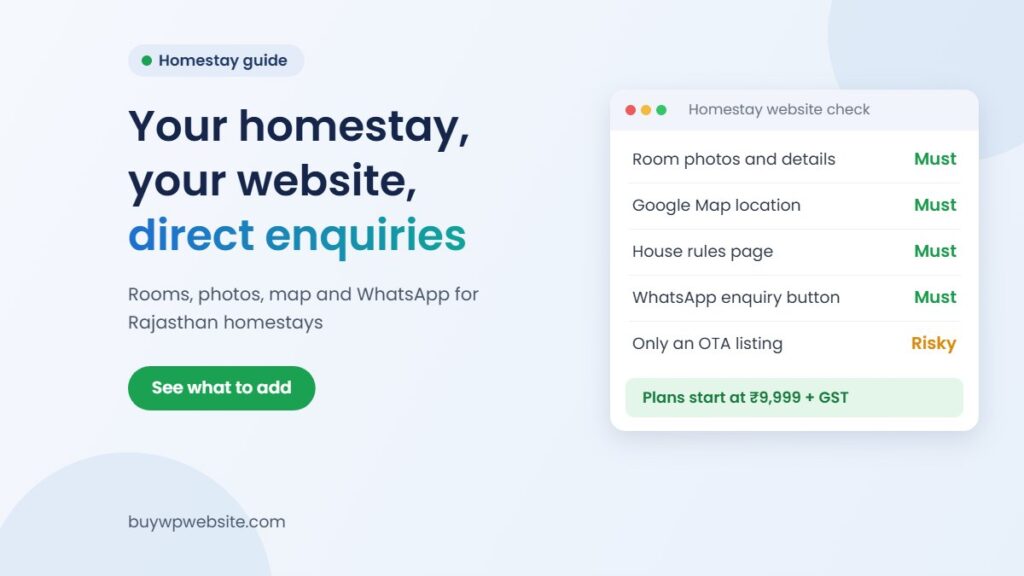
- Home: one strong photo, your homestay’s name, the city and area, and a clear WhatsApp button.
- Rooms: each room type with photos, bed type, number of guests, AC or non-AC, attached bathroom and the view.
- Photo gallery: rooms, rooftop, courtyard, food, the street outside. Use real photos, not stock images.
- Location and how to reach: an embedded Google Map, distance from the railway station, bus stand and airport, and nearby sights.
- House rules and policies: check-in and check-out times, ID requirement, advance and cancellation terms, food, smoking and pets.
- Contact: phone, WhatsApp, a short enquiry form and your Google reviews link.
If you host in a heritage haveli or offer home-cooked Rajasthani meals, desert camps or city walks, give them a short section or page each. Those details are often what makes a guest choose a homestay over a hotel. Start small and add pages as your homestay grows.
How to make a website for your homestay
You can build it yourself on a website builder or hire a designer. Either way, the steps are the same:
- Pick a domain close to your homestay’s name, for example yourhomestayname.com or .in.
- Collect content: 20 to 40 good photos taken in daylight, room details, house rules and your registration details if you have them.
- Build the pages listed above, mobile first, since many travellers will open your site on a phone.
- Add enquiry options: a WhatsApp button with a pre-filled message, tap-to-call and a short form asking for dates and number of guests.
- Link it everywhere: your Google Business Profile, Instagram bio, OTA messages where allowed, and your visiting card.
One honest point about bookings. Our website plans do not include a room booking engine, live availability calendar or online payment for rooms. Guests send an enquiry on WhatsApp, by phone or through the form, and you confirm the dates and advance yourself. For most small homestays this is simpler, as you already manage bookings on WhatsApp. If you later need a channel manager or booking engine, those are separate third-party tools.
Budget is the next question. Our website cost in India guide breaks down what you pay for design, domain, hosting and maintenance.
Connect your homestay website with Google Business Profile
Many guests look for a homestay on Google Maps, with searches such as “homestay near City Palace Udaipur”. If your homestay has a Google Business Profile, that is what shows up there, and your website is where they go next to see more.
One eligibility point: Google’s business eligibility guidelines say a business must make in-person contact with customers during its stated hours, and rental properties such as vacation homes are not eligible. The guidelines do not mention homestays by name, so read them carefully before you create a profile, and keep the profile truthful about where and when guests are received. If you are unsure, your website and WhatsApp still work without a profile.
If your homestay is eligible and you have a profile, use it well:
- Add your website link and WhatsApp number to the profile.
- Use the exact same name, address and phone number on both.
- Upload fresh photos regularly and reply to every review.
- Put a “Review us on Google” link on your website’s contact page.
For help with ads and local search later, Webuncles’ digital marketing team can assist.
How BuyWPWebsite can help
For most homestays, our Business website plan is the right fit. The Basic plan at ₹9,999 + GST gives you 5 pages, enough for Home, Rooms, Gallery, Location and Contact, and is ready in about 4 working days. If you want separate pages for each room, local sights or a blog, the Standard plan at ₹14,999 + GST covers 15 pages in about 7 working days.
Each annual plan includes website design, hosting, domain, SSL and maintenance. Changes during the plan’s maintenance period are free. What you get at the end depends on your plan; see our terms.
Want to see how your homestay would look first? Order the ₹999 + GST design preview, or message us on WhatsApp for a sample homestay website. You can also compare all plans on the Business website design page.
Frequently asked questions
Do I need a website if my homestay is already on booking apps?
It is not compulsory, but it helps. Booking apps bring new travellers, while your own website gives repeat guests, referrals and Google searchers a direct way to contact you without platform commission.
How many rooms are allowed under the Rajasthan homestay scheme 2026?
As per news reports on the 2026 scheme, a homestay unit can have up to 8 lettable rooms and 24 beds. Confirm the latest conditions with Rajasthan Tourism before registering.
Can guests book and pay online on my homestay website?
Not with our plans. We do not include a booking engine or room payment system. Guests enquire on WhatsApp, by phone or through a form, and you confirm the booking yourself.
How much does a homestay website cost in India?
It depends on pages and features. With BuyWPWebsite, the Business plan starts at ₹9,999 + GST for 5 pages, including hosting, domain, SSL and maintenance for the plan period.
Is a homestay website useful in India for small properties with 2 or 3 rooms?
Yes. Even a small homestay benefits from a page that shows real photos, location and rules, and a WhatsApp button. It makes you look genuine to guests who find you on Google or Instagram.
Should I mention my homestay registration on the website?
If you are registered under the state scheme, mentioning it on your About or Contact page adds trust. Show only details you are comfortable making public.