Quick answer: To launch a honey brand FSSAI-ready, you need an FSSAI registration or licence in your own name (or your packer’s), honey that passes the FSSAI honey standard in a lab test, and a label that carries the brand owner’s FSSAI logo and number, net quantity, MRP, batch and date details. Once those are in place, a simple product website and one or two marketplaces are enough to start selling honey online across India.
Honey looks like the easiest food product to brand: one ingredient, long shelf life, no cooking. That is exactly why buyers are suspicious of it. Adulteration stories have made Indian shoppers check labels and lab reports more than they do for most foods. This guide walks a small beekeeper, farmer group or trader through the compliance basics and then the selling side, so the brand earns trust from the first jar. It sits alongside our ODOP scheme guide and our article on branding and packaging for ODOP products.
Honey brand FSSAI basics: what you need before the first sale
Anyone who processes, packs or sells packaged honey is a food business operator. The application is made on FSSAI’s FoSCoS portal. Small businesses usually start with basic registration and move to a state licence as turnover grows; the turnover limits for each category are listed on FoSCoS and are revised from time to time, so check them when you apply rather than relying on an old blog post.
- If you pack honey yourself: the registration or licence covers your own premises and the processing you do there (filtering, warming, bottling).
- If a processor packs it for you: they need their own licence, and you as brand owner still need FSSAI registration. Both numbers can appear on the label.
- If you sell online: marketplaces ask for your FSSAI number at onboarding, and it should also be visible on your own website’s product page.
Beekeepers can also register with the National Bee Board on its Madhukranti portal, launched by the Ministry of Agriculture in 2021 to record beekeepers and trace honey back to its source. It is not the same as an FSSAI licence, but a registration number you can mention builds credibility with buyers who ask where the honey came from.
The FSSAI honey standard in plain words
FSSAI has a specific product standard for honey, separate from the general food rules. A product sold as “honey” must be the natural substance made by bees, with nothing added. The standard sets limits such as moisture below 20% and sucrose below 5%, plus a set of laboratory markers designed to catch sugar syrups. Antibiotic residues are not allowed.
What this means in practice for a small brand:
- Test every batch you buy in. If you aggregate honey from several beekeepers, a mix can fail even when most sources are clean. Use an FSSAI-notified lab and keep the report against the batch number.
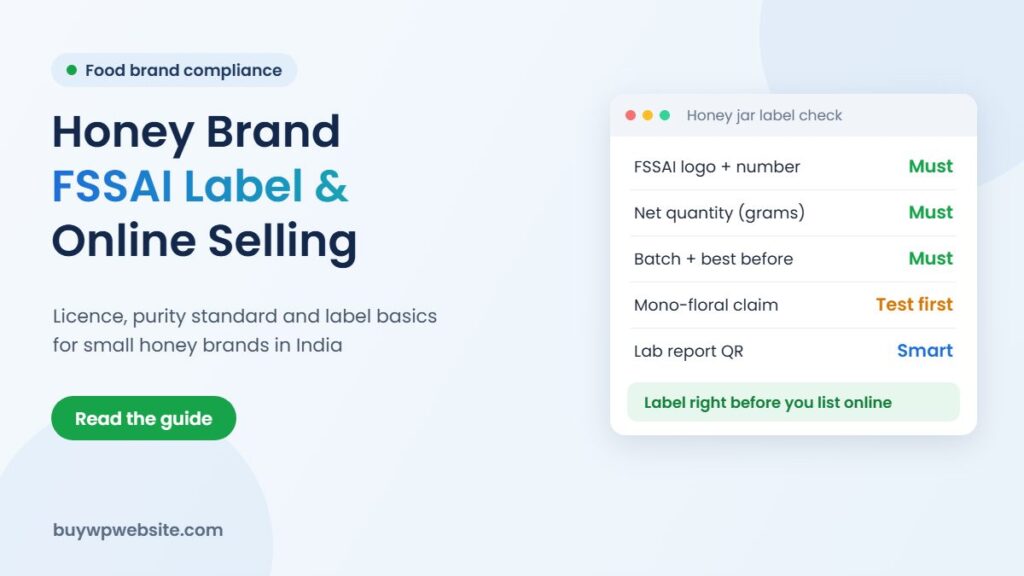
- Be careful with floral names. Calling a jar “mustard honey” or “ajwain honey” is a mono-floral claim. Under the standard, mono-floral honey needs at least 45% of its pollen from the named plant, which only a pollen analysis can confirm. Otherwise call it multi-floral or wild-flower honey.
- Avoid absolute words you can’t prove. “Pure”, “raw” and “unprocessed” are claims. FSSAI’s advertising and claims regulations apply, so use them only if your process and tests support them.
What must go on a honey jar label?
Two sets of rules apply together: the FSS (Labelling and Display) Regulations, 2020 and the Legal Metrology (Packaged Commodities) Rules, 2011. For a honey jar, the table below covers the items that matter most.
| Label item | What to print on a honey jar |
|---|---|
| Name of food | “Honey”, with the floral type only if tested (see above) |
| Veg symbol | Green veg logo on the front panel, near the name |
| FSSAI logo and number | Brand owner’s number, plus the packer’s if different |
| Brand owner name and address | Full address; packer details too if a third party packs |
| Net quantity | In grams (honey is sold by weight, not ml) |
| MRP | Inclusive of all taxes, in rupees |
| Batch / lot number | Links the jar to your lab report |
| Date marking | Date of manufacture or packing, and best before |
| Consumer care | Phone number and email for complaints |
| Storage advice | For example, “store in a cool, dry place; crystallisation is natural” |
Honey with nothing added is a single-ingredient food, and FSSAI’s labelling FAQs list single-ingredient foods among those exempt from a nutrition panel. Many brands print one anyway because shoppers compare it. If you add anything (ginger, tulsi, cinnamon), the product stops being plain honey: it needs an ingredient list, a nutrition panel and possibly a different product category. Check with a food technologist before you launch flavoured variants.
Building a honey brand people trust
Compliance gets you onto the shelf; trust is what makes a customer reorder. Honey buyers want proof of origin more than clever design.
Tell the source story honestly
Say where the hives stand, which season the honey was harvested and who the beekeepers are, with real photos. In Rajasthan, many beekeepers move boxes to mustard fields in the rabi season; if that is your honey, show it. Never use stock photos of hives in another country.
Explain crystallisation before customers complain
Mustard honey in particular sets solid quickly in winter. Customers often think solid honey is fake. A line on the label and a short note on your website (“gently warm the jar in water to make it liquid again”) prevents returns and bad reviews.
Share the lab report
Put a QR code on the jar that opens the lab report for that batch on your website. It costs almost nothing and answers the purity question better than any slogan.
Selling honey online: website, marketplaces and shipping
Most new honey brands start on Amazon or Flipkart and quickly find two limits: the platform’s fees, and no direct relationship with the customer. A small online store of your own fixes the second problem and gives you a place for the origin story, lab reports and repeat orders. Marketplaces and ONDC-connected apps then bring discovery.
- Product pages: show the full label (front and back photos), net weight, floral type, harvest season and the batch lab report.
- Online label rules: Legal Metrology rules require online sellers to show the mandatory declarations on the listing, and FSSAI expects key label information to be visible before purchase.
- Packaging for courier: glass looks premium but breaks. Use thick-walled jars with shrink bands and moulded inserts, or food-grade PET for larger packs.
- Bulk and gifting: a separate enquiry form for corporate Diwali gifting and wholesale orders often brings bigger orders than retail jars.
Our guide to selling ODOP products online compares these channels in more detail.
Can ODOP support help a honey business in Rajasthan?
Honey is not itself one of Rajasthan’s 41 notified district products. Some districts have broad “agro-based” products (Bharatpur and Hanumangarh, for example), so ask your District Industries and Commerce Centre (DIC) whether a honey unit qualifies there. If it does, the Rajasthan ODOP Policy 2024 offers, subject to approval:
- 75% of certification costs such as FSSAI or ISO, up to ₹3 lakh one time (clause 7.3)
- 60% of an e-commerce website or cataloguing cost, up to ₹75,000 one time (clause 7.8)
- 75% of marketplace fees, up to ₹1 lakh a year for two years (not shipping)
Nothing here is guaranteed; eligibility and amounts are decided by the department, so confirm with your DIC before you spend.
How BuyWPWebsite and Webuncles can help
We are a private technology provider, not a government office. For honey brands we build a WooCommerce online store (₹25,000 + GST, 10 pages, 10 products, payments and shipping set up) with product pages designed around lab reports and batch details. If you only need a brand website with an enquiry form for bulk orders, our business website plans start at ₹9,999 + GST. Our sister company Webuncles has done logo and label design for products and handles e-commerce solutions such as marketplace listing.
ODOP technology partner
The scheme supports your business. We build the technology behind it.
From your first website to marketing and business software, one team handles the digital side of your ODOP business, so you can focus on making your product.
- Online store or business website
- Logo, packaging, label, brochure and flyer design
- Product cataloguing for your website and marketplaces
- SEO, Google Ads and Meta (Facebook & Instagram) Ads
- ERP, CRM, billing and finance software
Proper paperwork: a written quotation before we start and a GST invoice (bill) for the work we deliver — the documents your DIC usually asks for with a claim.
Chat on WhatsApp See website plans
More help: ODOP scheme guide · Rajasthan ODOP policy & subsidies · All ODOP guides
Please note: ODOP subsidies, grants and reimbursements are approved and paid only by the government, through your District Industries & Commerce Centre (DIC) or the scheme's official portal. BuyWPWebsite and Webuncles are private technology service providers, not a government office or agent. We cannot approve, guarantee, refund or reimburse any scheme amount, and our fees are for the work we deliver, payable as per our terms whether or not a claim is approved. Scheme rules change; please confirm the current rules with your DIC before you spend.
Frequently asked questions
Do I need an FSSAI licence to sell honey from my own bees?
If you pack and sell it under a label, yes: you need at least FSSAI basic registration, and a state licence once your turnover crosses the limit shown on FoSCoS. Selling unpacked honey only to a processor is different, but the processor then needs its own licence.
Can I call my product “mustard honey”?
Only if a pollen analysis shows that at least 45% of the pollen comes from mustard, which is the FSSAI threshold for a mono-floral claim. Without that report, “multi-floral honey” is the safe name.
Is a nutrition table compulsory on a honey label?
FSSAI’s labelling FAQs exempt single-ingredient foods without additives from the nutrition panel, and plain honey fits that description. Flavoured or infused honey does not, so it needs a nutrition table.
Why does my honey turn solid, and should I mention it?
Crystallisation is natural and depends on the flower source and temperature; mustard honey sets faster than most. Mention it on the label and website so customers don’t mistake it for adulteration.
Sources: FSSAI honey standard and labelling FAQs, Legal Metrology (Packaged Commodities) Rules, 2011, PIB release on the Madhukranti portal, Rajasthan ODOP Policy 2024. Facts checked in November 2026.