Quick answer: Brand story writing for a district product means explaining, in a few honest lines, where your product comes from, who makes it, how it is made and why that matters to the buyer. Build it from facts you can prove, write it in plain language, and then reuse short versions of the same story on your packs, website, marketplace listings and social media.
Most makers in Rajasthan already have a strong story. A family that has woven Kota Doria for generations, a Nagaur spice unit that sorts pan methi by hand, a Jodhpur furniture workshop that still does hand carving: these are stories buyers pay for. The problem is that the story usually stays in the owner’s head and never reaches the label or the product page. This guide gives you a method to write it down.
Why district products need a written story
District products often compete with cheaper copies that look similar in a photo. A machine-made print can look like hand block printing on a phone screen; any white stone can be called “Makrana-type”. The written story is how a buyer tells the difference before touching the product. It also helps:
- Marketplaces and B2B buyers: category managers, exporters and hotel buyers want to know origin and process before they place bulk orders.
- Government and fair visibility: under the ODOP scheme, district products get showcased at fairs, malls and portals. A clear story makes your stall or listing stand out from ten others selling the same product.
- Pricing: a buyer who understands that a piece took four days by hand argues less about price.
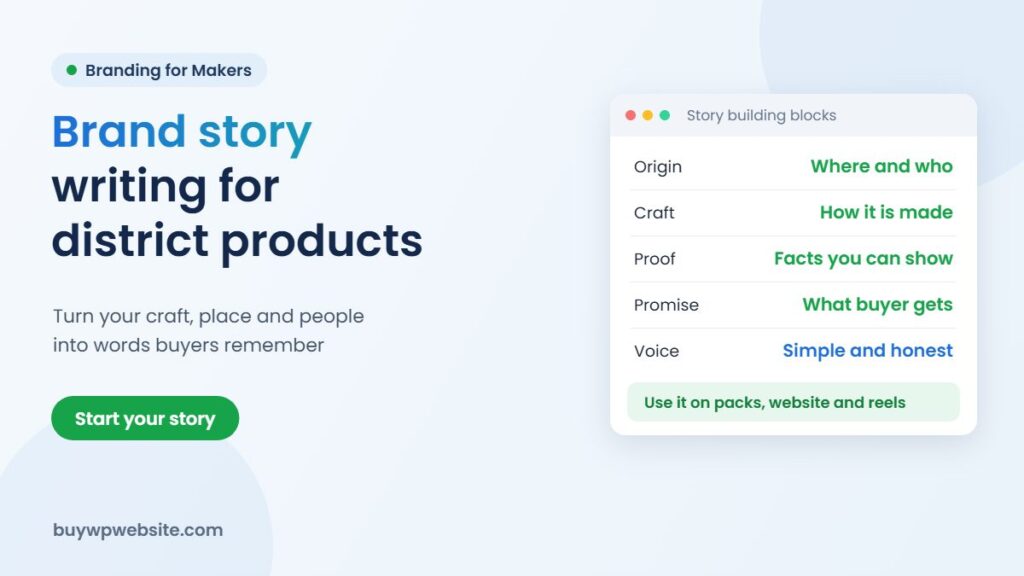
The five building blocks of a brand story
Before writing a single sentence, collect raw material under five headings. Talk to the oldest person in the business; they usually remember the details that make a story real.
| Block | Questions to answer | Example of a raw note |
|---|---|---|
| Origin | Which town or village? Since when? Why here? | Started by grandfather in our mohalla, near the clay source |
| Craft | What steps are done by hand? What tools or materials are special? | Natural dyes boiled in copper vessels, blocks carved by our own karigar |
| People | Who makes it? Women artisans? A cluster of families? | Six women from nearby villages do the finishing |
| Proof | What can you show? GI registration, certificates, awards, photos? | FSSAI licence, process photos, fair participation letters |
| Promise | What does the buyer get that a copy cannot give? | Colours that are skin-safe and age softly |
Only write down what is true and checkable. If you are not sure of a year, say “for three generations” instead of guessing “since 1952”.
Brand story writing in three lengths
You will need the story at different sizes. Write the long one first and cut it down.
The one-liner (10 to 15 words)
For the label, Instagram bio and marketplace brand field. Example: “Hand-printed in Bagru by one family of chhipa printers, using natural dyes.”
The short story (60 to 100 words)
For product pages, catalogues and the back of a pack. Cover origin, craft and promise in one paragraph. Name the place and the process; leave out generic words like “premium quality” and “best in class” that every competitor also uses.
The long story (300 to 500 words)
For your website About page, export catalogue and press. Add people, history, a photo of the workshop and the proof points. This is also where you can mention your district’s place in the state ODOP list, if you make the notified product.
Lines that work and lines that do not
The difference between a forgettable story and a strong one is usually specificity.
| Weak line | Stronger line | Why it works |
|---|---|---|
| We offer premium quality handicrafts | Each Thewa piece is worked and fused by hand in our Pratapgarh workshop | Names the craft and the process |
| Traditional products since generations | Our family has woven in Kaithoon for three generations | Names a real place and a checkable claim |
| 100% natural and pure | Cold-pressed in small batches from mustard bought at local mandis | Shows how, not just a claim |
| Customer satisfaction is our motto | Every order is checked and packed by the person who made it | Gives the buyer a picture |
A good test: if a competitor in the next district could paste your sentence onto their label without changing a word, it is not your story yet.
Mistakes small makers make with their story
- Copying a big brand’s tone. Corporate phrases sound fake on a handmade product. Write as you would explain it to a visitor in your workshop.
- Exaggerating claims. Words like “organic”, “GI-certified” or “export quality” have meanings. Use them only if you hold the certificate or registration. Food claims also have to follow FSSAI labelling rules.
- Using government logos. The State Emblem and scheme logos cannot be used on private branding. Mention a scheme in words if relevant, not as a badge.
- Telling the story only once. A story written for the website and never used on packs, reels or WhatsApp catalogues does very little.
- Leaving out the buyer. The best stories end with what the buyer gets: comfort, authenticity, a gift with meaning.
Where to use your story once it is written
- Packaging: one-liner on the front, short story on the back or a swing tag. Our hub on ODOP branding and packaging design covers layouts.
- Website: long story on the About page, short story on each product page, process photos in a gallery.
- Marketplaces: brand description and A+ content where the platform allows it.
- Fairs and B2B: a printed one-page story in your catalogue and a QR code linking to your website.
- Social media: break the long story into a series of short videos, one block each.
How BuyWPWebsite and Webuncles can help
Our websites are built with an About page, gallery and blog, so your story has a proper home. A business website starts at ₹9,999, and the Standard and Premium plans include training so you understand how the site works. If you sell direct, a WooCommerce store lets every product page carry its own short story. For labels and brand identity, Webuncles offers graphic design, and for spreading the story online, digital marketing support.
ODOP technology partner
The scheme supports your business. We build the technology behind it.
From your first website to marketing and business software, one team handles the digital side of your ODOP business, so you can focus on making your product.
- Online store or business website
- Logo, packaging, label, brochure and flyer design
- Product cataloguing for your website and marketplaces
- SEO, Google Ads and Meta (Facebook & Instagram) Ads
- ERP, CRM, billing and finance software
Proper paperwork: a written quotation before we start and a GST invoice (bill) for the work we deliver — the documents your DIC usually asks for with a claim.
Chat on WhatsApp See website plans
More help: ODOP scheme guide · Rajasthan ODOP policy & subsidies · All ODOP guides
Please note: ODOP subsidies, grants and reimbursements are approved and paid only by the government, through your District Industries & Commerce Centre (DIC) or the scheme's official portal. BuyWPWebsite and Webuncles are private technology service providers, not a government office or agent. We cannot approve, guarantee, refund or reimburse any scheme amount, and our fees are for the work we deliver, payable as per our terms whether or not a claim is approved. Scheme rules change; please confirm the current rules with your DIC before you spend.
Frequently asked questions
How long should a brand story be?
Keep three versions: a one-liner of 10 to 15 words, a short version of 60 to 100 words and a long version of 300 to 500 words. Most buyers will only read the short one, so make it count.
Should I write my brand story in Hindi or English?
Write it in the language your buyers read. Many Rajasthan makers keep English for the website and marketplaces and a Hindi version for local packs, fairs and WhatsApp.
Can I mention ODOP in my brand story?
You can say in words that your product is your district’s notified ODOP product, if that is true. Do not use government or scheme logos, and do not imply official endorsement of your brand.
What if my business is new and has no history?
Tell the story of the place, the craft and why you started. A first-generation maker who learnt from local karigars and wants to take the craft online is a good story too, as long as it is honest.
Facts checked in November 2026. Labelling and certification rules can change; confirm current requirements with the relevant authority.