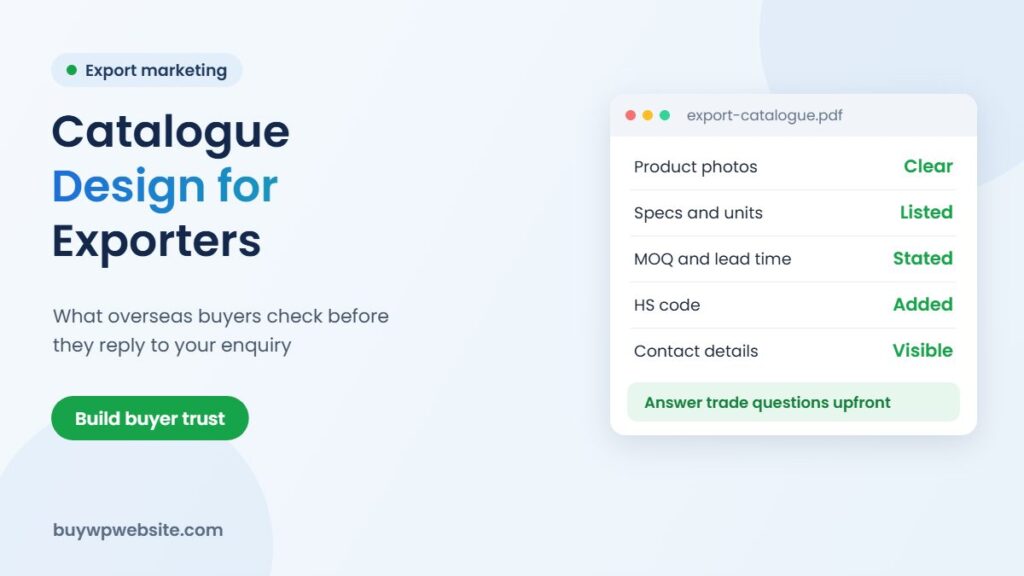
Quick answer: Good catalogue design for exporters is less about decoration and more about answering a foreign buyer’s questions before they ask. A buyer wants clear photos, exact specifications in their units, minimum order quantity, lead time, packing details, certifications and a contact person who replies. Put prices in a separate price list, keep the catalogue short, and publish the same content on your website so buyers can check you are real.
Most small Rajasthan manufacturers already make products that sell abroad: marble and granite, textiles, wooden furniture, Thewa jewellery, spices and namkeen. What usually holds them back is not quality but presentation. A buyer in Dubai or Germany sees dozens of PDF catalogues every week, and the ones that get replies are the ones that make comparison easy. This guide is part of our ODOP scheme guide series for district product makers.
Catalogue design for exporters: what buyers check first
An importer or sourcing agent scans a catalogue in a few minutes, looking for reasons to shortlist or reject you. The questions that decide it are usually practical:
- Can you make what I need? Product range, sizes, finishes, materials and customisation options.
- Can you make it consistently? Production capacity, quality checks, certifications and factory photos.
- Can I land it at a sensible cost? MOQ, packing per carton, carton dimensions and weight, and the port you ship from.
- Can I trust you? Company name, address, IEC, GST, website, and a named person with a phone and WhatsApp number.
If your catalogue answers these four, a buyer can send a precise enquiry. If it doesn’t, they move to the next supplier rather than write back with ten questions.
Pages every export catalogue should have
Keep the structure simple. Twelve to thirty pages is enough for most small units; a huge catalogue with every variation often hides your best products.
| Section | What to include | Why the buyer cares |
|---|---|---|
| Cover | Company name, product category, one strong product photo | Sets the first impression and makes the file easy to find later |
| About the company | Year started, location, factory size, team, key machines | Shows you are a real manufacturer, not a reseller |
| Product range overview | Categories with one photo each and page numbers | Lets the buyer jump straight to what they source |
| Product pages | Photos, item code, size, material, finish, weight, options | The core of the catalogue; used for comparison |
| Quality and certifications | Certificates you actually hold, testing done | Reduces risk for the buyer |
| Packing and shipping | Inner and outer packing, carton size, loadability, port | Needed to calculate landed cost |
| Contact page | Named person, phone, WhatsApp, website, address | Makes it easy to reply |
Designing product pages that answer trade questions
Photos that show the real product
Use clean, well-lit photos on a plain background, plus one or two in-use or close-up shots showing texture, joinery, stitching or stone grain. Avoid heavy filters; if the shipment looks different from the photo, you lose the repeat order. For natural materials such as marble or sandstone, add a line saying that colour and veining vary by lot.
Specifications in the buyer’s units
Give dimensions in both centimetres and inches where your buyers are in the US, and weights in kilograms. State material, finish, thread count or GSM for textiles, net weight and shelf life for food products. Give every product a short item code so the buyer can quote it in an enquiry.
MOQ, lead time and packing
Even a range is fine, such as “MOQ from one carton per design” or “lead time depends on order size”. What frustrates buyers is having no indication at all. Add the HS code for each product family so the importer can check duties; your customs broker or the DGFT portal can help you confirm the right code.
Keep prices out of the main catalogue
Prices change with raw material costs, exchange rates and order size. Put them in a separate price list that you send after the first enquiry. It lets you update prices without redesigning the catalogue, and you can quote different terms to different markets.
When you do quote, say clearly which Incoterm you mean, such as FOB (buyer takes over once goods are loaded at your port) or CIF (you pay freight and insurance to the buyer’s port). Mismatched assumptions about who pays freight are a common cause of disputes with first-time buyers.
PDF catalogue or online catalogue?
You need both. The PDF goes by email and WhatsApp; the website proves you exist and lets buyers browse without downloading anything.
| Format | Best for | Watch out for |
|---|---|---|
| Print-ready PDF | Trade fairs, email attachments, sending to agents | Keep the file small (compress images) so it opens on a phone |
| Website product pages | Being found on Google, credibility checks, sharing single products | Must load fast and match the PDF codes |
| Printed booklet | Exhibitions and buyer visits | Print only what you will use; ranges change |
| WhatsApp catalogue | Quick follow-ups with known buyers | Not a substitute for a proper website |
Mistakes that cost exporters replies
- Using stock photos or images copied from other suppliers. Experienced buyers spot them quickly.
- Listing certificates you are still applying for. Say “in process” or leave them out.
- Writing long paragraphs about heritage and no specifications. Keep the story to one page.
- Different item codes in the PDF, the website and the price list.
- A generic email address with no named person, or a phone number nobody answers.
- A 40 MB file that buyers cannot open on mobile data.
Packaging matters too, because buyers photograph samples and show them to their own customers. Our guide to ODOP branding and packaging design covers labels, boxes and brand consistency.
ODOP support that can help with export marketing
If you make your district’s notified ODOP product in Rajasthan, the Rajasthan ODOP Policy 2024 has provisions that fit export marketing. These include one-time assistance of 60% (up to ₹75,000) for an e-commerce website and cataloguing, help with participation in trade fairs in India and abroad, and 75% (up to ₹3 lakh) for certifications such as BIS, ISO or ZED. All of these are subject to eligibility and approval, so confirm the current rules and documents with your District Industries & Commerce Centre (DIC) before you spend.
How BuyWPWebsite and Webuncles can help
We build the online half of your catalogue. A business website (plans start at ₹9,999 + GST) gives you product pages, an enquiry form, WhatsApp chat and Google Search Console set up, so buyers can verify you. If you also sell retail, a WooCommerce online store adds payments and shipping. For the PDF itself, the Webuncles graphic design team can lay out a catalogue that matches your website. When your range changes, our team updates the product pages for you: free during the plan’s maintenance period, and ₹1,000/hour for customisation after that.
ODOP technology partner
The scheme supports your business. We build the technology behind it.
From your first website to marketing and business software, one team handles the digital side of your ODOP business, so you can focus on making your product.
- Online store or business website
- Logo, packaging, label, brochure and flyer design
- Product cataloguing for your website and marketplaces
- SEO, Google Ads and Meta (Facebook & Instagram) Ads
- ERP, CRM, billing and finance software
Proper paperwork: a written quotation before we start and a GST invoice (bill) for the work we deliver — the documents your DIC usually asks for with a claim.
Chat on WhatsApp See website plans
More help: ODOP scheme guide · Rajasthan ODOP policy & subsidies · All ODOP guides
Please note: ODOP subsidies, grants and reimbursements are approved and paid only by the government, through your District Industries & Commerce Centre (DIC) or the scheme's official portal. BuyWPWebsite and Webuncles are private technology service providers, not a government office or agent. We cannot approve, guarantee, refund or reimburse any scheme amount, and our fees are for the work we deliver, payable as per our terms whether or not a claim is approved. Scheme rules change; please confirm the current rules with your DIC before you spend.
Frequently asked questions
How many products should an export catalogue show?
Show your best-selling and most exportable products, not every variation. A focused catalogue with clear codes is easier to compare. Mention that more designs are available on request or on your website.
Should I include prices in my export catalogue?
Usually not. Keep a separate price list with the Incoterm, currency and validity date, and send it after the buyer shares quantity and destination.
Is a PDF catalogue enough, or do I need a website?
A PDF alone is hard to verify. Most buyers will search your company name before replying, so a simple website with the same products and contact details builds trust.
Can the ODOP scheme pay for my catalogue?
The Rajasthan ODOP Policy 2024 includes one-time support for an e-commerce website and cataloguing for eligible units, subject to approval. Check eligibility and the claim process with your DIC first.
Sources: Rajasthan ODOP Policy 2024, DGFT. Facts checked in November 2026.