
Quick answer: Good shipping for small business India starts with three choices: who carries the parcel (India Post, a single courier, or a shipping aggregator that books many couriers), how you charge the customer (free, flat or weight-based), and how you pack so you are billed on the right weight. Most small online sellers begin with an aggregator for doorstep pickup and pan-India reach, keep India Post for remote pin codes, and switch on cash on delivery only where returns stay low.
If you make an ODOP product in Rajasthan, shipping decides whether your first online orders make money or lose it. This guide explains the options in plain terms. For the wider picture of selling online, read our hub on how to sell ODOP products online, and for the scheme itself see the complete ODOP scheme guide.
Which shipping options do small online sellers in India have?
There are four practical routes. Most units end up using two of them side by side.
| Option | How it works | Best for |
|---|---|---|
| India Post (Speed Post / parcel) | You drop parcels at the post office, or ask about business pickup in larger towns | Remote villages and hill pin codes; documents and light items |
| Direct courier account | You sign a contract with one courier company | Sellers already shipping steady volumes every month |
| Shipping aggregator | One dashboard and wallet to book several couriers, with pickup from your unit | New sellers, mixed order sizes, COD orders |
| Marketplace logistics | Amazon, Flipkart and similar platforms arrange pickup for orders placed on their site | Orders that come through that marketplace only |
A shipping aggregator is usually the easiest start. You recharge a wallet, enter the parcel weight and size, compare courier rates for that pin code and print the label. The courier picks up from your workshop. You do not need a minimum monthly volume to begin with most of them, but read the terms on weight disputes and COD remittance cycles before you sign up.
How is shipping for small business India actually charged?
Couriers charge on whichever is higher: the actual weight on the scale or the volumetric weight of the box. Volumetric weight is usually worked out as length × breadth × height in centimetres divided by 5,000 (some services use a different divisor, so check yours).
This matters a lot for products like wooden handicrafts, blue pottery, lampshades or quilts, which are light but bulky. A 40 × 30 × 20 cm carton works out to 4.8 kg volumetric weight even if the item inside weighs 1.5 kg, so you pay for 4.8 kg. Heavy, compact goods such as spices, namkeen or stone coasters behave the other way: the scale weight decides.
Other parts of the bill
- Zone: local, within state, metro to metro, rest of India and special zones (North-East, J&K) are priced differently.
- COD fee: a fixed charge or a percentage of order value, whichever is higher, on cash-on-delivery orders.
- RTO charges: if the customer refuses the parcel, you usually pay for the return trip as well.
- Weight slabs: rates jump in slabs (for example every 500 g), so trimming a box by a few centimetres can drop you into a cheaper slab.
Packing that cuts cost and breakage
Packing is where small sellers lose the most money without noticing. A few habits help:
- Use the smallest box that still allows cushioning. Keep three or four standard box sizes in stock instead of cutting cartons by hand for every order.
- Measure and weigh every packed parcel and enter the true figures while booking. Wrong figures lead to weight disputes and extra charges later.
- For fragile items (pottery, glass, stone, Thewa jewellery boxes) use double-wall cartons, corner protection and a “fragile” label, and take a photo of the packed parcel before sealing.
- Food products need sealed inner packing, FSSAI-compliant labels and moisture protection, especially in the monsoon.
- Put an invoice inside the parcel and keep a copy for GST records.
Good packaging also builds your brand. Our guide on ODOP branding and packaging design covers how to make the unboxing look professional without overspending.
Free shipping, flat rate or real-time rates?
Customers in India respond well to “free delivery”, but someone always pays. Three common approaches:
- Built into the price: add your average shipping cost to the product price and show free delivery. Simple, but you lose money on far-away or heavy orders.
- Flat rate: one fixed delivery charge per order, often waived above a minimum order value. Encourages bigger baskets.
- Weight or zone based: the website calculates shipping from weight and pin code. Fair, but the checkout looks more complicated.
For most ODOP units, a flat rate with a free-delivery threshold is a good balance. Work out your real average cost from your first 30 to 50 orders, then adjust the threshold.
Cash on delivery and returns: keeping RTO under control
COD still matters for first-time buyers in smaller towns, but every refused parcel costs you two-way freight and blocks your stock. To reduce return-to-origin (RTO) orders:
- Confirm COD orders on WhatsApp or by phone before dispatch.
- Offer a small discount for prepaid orders instead of charging extra for COD.
- Turn COD off for very high-value items or for pin codes with repeated refusals.
- Use clear product photos and exact size or colour details so the parcel matches what the buyer expected.
Paperwork: invoices, e-way bills and GST
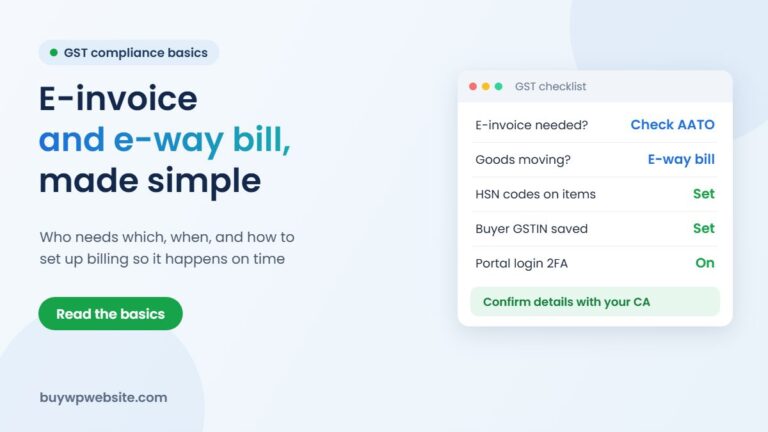
Every parcel should travel with a tax invoice or bill of supply. If you are GST-registered and a single consignment is worth more than ₹50,000, an e-way bill is generally required for inter-state movement; intra-state limits are set by each state, so confirm Rajasthan's current rule with your accountant. Many couriers and aggregators can generate the e-way bill for you when you enter the invoice details.
Keep shipping charges and COD fees in your books properly. Shipping recovered from the customer is normally part of the taxable value of the sale, so ask your CA how to show it on your invoices.
Does ODOP support help with logistics costs?
Under the Rajasthan ODOP Policy 2024, clause 7.8 can reimburse 75% of marketplace fees up to ₹1 lakh a year for two years, but shipping and courier charges are not covered. The same clause offers one-time help of 60%, up to ₹75,000, for an e-commerce website and cataloguing. Both are subject to approval, so confirm eligibility and the current guidelines with your District Industries & Commerce Centre (DIC) before you spend.
For export parcels, ask at your head post office about Dak Ghar Niryat Kendra (DNK) services, which India Post runs to help small exporters with documentation and booking.
How we help you sell and ship from your own website
Our WooCommerce online store (₹25,000 + GST) comes with payments and shipping set up: delivery zones, flat-rate or weight-based rules, a free-delivery threshold and COD on or off as you choose. If you only need a catalogue site that takes enquiries on WhatsApp, our business websites start at ₹9,999 + GST. For larger set-ups, such as order flows connected to accounting or a courier dashboard, the Webuncles team handles e-commerce solutions and integrations.
ODOP technology partner
The scheme supports your business. We build the technology behind it.
From your first website to marketing and business software, one team handles the digital side of your ODOP business, so you can focus on making your product.
- Online store or business website
- Logo, packaging, label, brochure and flyer design
- Product cataloguing for your website and marketplaces
- SEO, Google Ads and Meta (Facebook & Instagram) Ads
- ERP, CRM, billing and finance software
Proper paperwork: a written quotation before we start and a GST invoice (bill) for the work we deliver — the documents your DIC usually asks for with a claim.
Chat on WhatsApp See website plans
More help: ODOP scheme guide · Rajasthan ODOP policy & subsidies · All ODOP guides
Please note: ODOP subsidies, grants and reimbursements are approved and paid only by the government, through your District Industries & Commerce Centre (DIC) or the scheme's official portal. BuyWPWebsite and Webuncles are private technology service providers, not a government office or agent. We cannot approve, guarantee, refund or reimburse any scheme amount, and our fees are for the work we deliver, payable as per our terms whether or not a claim is approved. Scheme rules change; please confirm the current rules with your DIC before you spend.
Frequently asked questions
Which courier is cheapest for small sellers in India?
There is no single cheapest courier. Rates change by pin code, weight slab and payment mode. An aggregator lets you compare several couriers for each parcel, which is the easiest way to find the lowest rate for that particular order.
Do I need GST registration to ship products online?
It depends on your turnover, your product and whether buyers are outside Rajasthan. Marketplaces usually want a GSTIN before they list you, while a small seller shipping only within the state may qualify for an exemption. Check with your CA before you start.
How can I stop paying extra for weight disputes?
Weigh and measure every packed parcel, enter exact figures, use standard box sizes and keep photos of the parcel on the scale. Most aggregators accept photo proof when you raise a dispute.
Can my WooCommerce store calculate shipping by pin code?
Yes. WooCommerce supports shipping zones by state or pin code with different rates for each, and can hide COD for zones you choose. We configure these rules when we set up your store.
Facts checked in November 2026. ODOP benefits are subject to approval under the Rajasthan ODOP Policy 2024; confirm with your DIC.