Quick answer: Trademark registration for a small business in India starts with choosing a distinctive brand name, searching the Trade Marks Registry for similar marks, and filing an application (Form TM-A) in the right class. Online filing costs ₹4,500 per class for individuals, startups and small enterprises, and ₹9,000 per class for others. You can use ™ once you have filed, but ® only after the mark is registered. A registration lasts ten years and can be renewed.
Many ODOP units in Rajasthan sell under the product’s own name, for example “Kota Doria sarees” or “Bikaneri namkeen”. That describes what you sell, but it is not a brand. A brand is the name buyers ask for again and that a competitor cannot copy. This guide explains how to pick one and protect it, as part of our ODOP scheme guide series. It is general information, not legal advice; for anything contested, speak to a trademark attorney.
Why a product name is not a brand
Some district product names are protected as Geographical Indications (GIs). Kota Doria and Bikaneri Bhujia, for example, are registered GIs. A GI tells buyers where a product comes from, and authorised producers from that region can use it. It does not separate your business from the other producers in your cluster.
A trademark does that. It protects a name, logo or label that identifies your goods. That is why your family name plus a word, or an invented name, is far more valuable over time than the product name alone. If you sell online, buyers searching for your brand should find you, not a reseller using a similar name.
How to choose a brand name that can be registered
The Registry refuses marks that simply describe the product or its quality, or that are confusingly similar to an existing mark. Names generally sit on a scale from weak to strong:
| Type of name | Example style | Chance of registration |
|---|---|---|
| Generic | “Marble Tiles”, “Pure Spices” | Very low; anyone must be able to use these words |
| Descriptive | “Best Quality Namkeen”, “Royal Jaipur Gems” | Low; often objected to |
| Suggestive | A name hinting at a quality without saying it | Reasonable |
| Family or coined name | Your surname plus a word, or an invented word | Good, if no similar mark exists |
A quick checklist before you decide
- Easy to say in Hindi and English, and easy to spell when someone hears it on a phone call.
- Not too close to a big brand in your category, even with a different spelling.
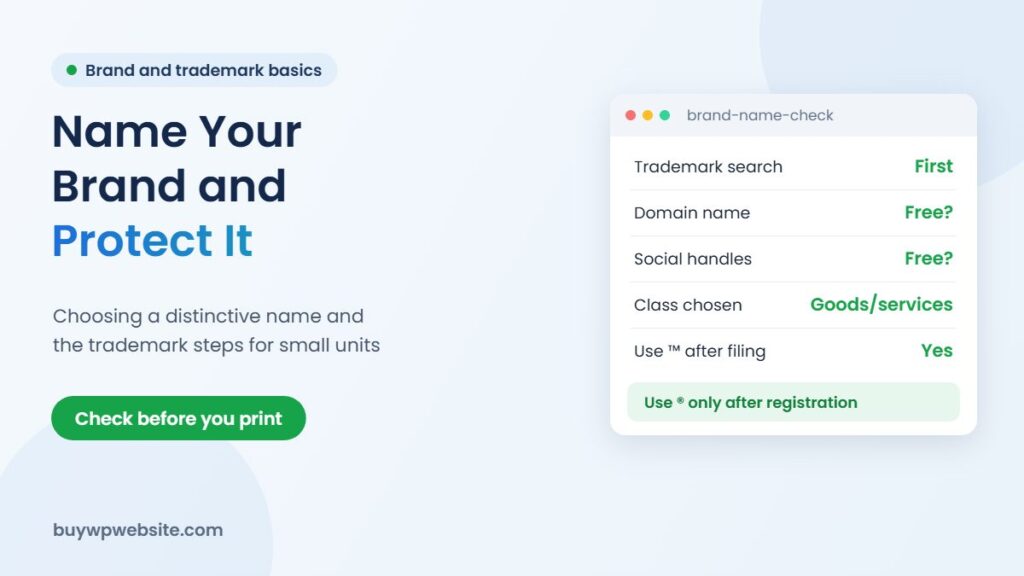
- A matching domain name is available, along with Instagram and Facebook handles.
- It works for products you may add later, not only today’s range.
- It has no unflattering meaning in the markets you sell to.
Once you have a shortlist, run a free public search on the IP India website for identical and similar names in your class.
Trademark registration for a small business: the steps
- Pick the class. Trademarks are filed under 45 classes: 1 to 34 cover goods and 35 to 45 cover services. Textiles, jewellery, food, stone and furniture all fall in different classes, and each class needs a separate fee.
- Search. Check the Registry database for similar marks in the same and related classes.
- File Form TM-A. Apply online with the name or logo, applicant details, goods description, and date of first use (or “proposed to be used”).
- Examination. The Registry examines the application. If there is an objection, you usually get a short window to reply, and missing it can lead to the application being treated as abandoned.
- Publication. If accepted, the mark is advertised in the Trade Marks Journal, and others can oppose it during the notice period.
- Registration. If there is no successful opposition, the certificate is issued. It is valid for ten years and renewable.
| Applicant type | Online filing fee per class (TM-A) |
|---|---|
| Individual, startup or small enterprise | ₹4,500 |
| Others (e.g. larger companies) | ₹9,000 |
To claim the lower fee as a small enterprise, you will need to show proof of your status, such as Udyam registration. Professional fees for an attorney or agent are extra. Fees and rules can change, so check the current schedule on the IP India site before filing.
Using ™ and ® correctly
Use ™ next to your brand once the application is filed. Use ® only after the registration certificate has been issued; using it earlier misrepresents the mark as registered. Put the symbol on labels, packaging, your website header and catalogues so buyers and competitors know you claim the name.
Logo, label and website: keep them consistent
If you file a word mark (the name in plain letters), you protect the name in any style. A logo can be filed separately. Whatever you register, use it the same way everywhere: product labels, boxes, your website, marketplace listings and social profiles. Inconsistent use weakens the brand in the buyer’s mind. Our guide to ODOP branding and packaging design covers how to carry one look across all of these.
Can ODOP support cover trademark costs?
The Rajasthan ODOP Policy 2024 includes one-time assistance for certification and IPR of 75%, up to ₹3 lakh, for eligible units making their district’s ODOP product. Whether a particular trademark filing qualifies, and what documents are needed, is decided under the scheme guidelines. Confirm with your District Industries & Commerce Centre (DIC) before you file, and keep all receipts.
How we can help with your brand online
We don’t file trademarks, but we help you use your brand properly once you have chosen it. A business website on your own domain (plans start at ₹9,999 + GST) shows your brand name, logo and products consistently, with on-page SEO so people searching your brand find you. For logos and labels, Webuncles has done logo and label design for products and offers a full graphic design service.
ODOP technology partner
The scheme supports your business. We build the technology behind it.
From your first website to marketing and business software, one team handles the digital side of your ODOP business, so you can focus on making your product.
- Online store or business website
- Logo, packaging, label, brochure and flyer design
- Product cataloguing for your website and marketplaces
- SEO, Google Ads and Meta (Facebook & Instagram) Ads
- ERP, CRM, billing and finance software
Proper paperwork: a written quotation before we start and a GST invoice (bill) for the work we deliver — the documents your DIC usually asks for with a claim.
Chat on WhatsApp See website plans
More help: ODOP scheme guide · Rajasthan ODOP policy & subsidies · All ODOP guides
Please note: ODOP subsidies, grants and reimbursements are approved and paid only by the government, through your District Industries & Commerce Centre (DIC) or the scheme's official portal. BuyWPWebsite and Webuncles are private technology service providers, not a government office or agent. We cannot approve, guarantee, refund or reimburse any scheme amount, and our fees are for the work we deliver, payable as per our terms whether or not a claim is approved. Scheme rules change; please confirm the current rules with your DIC before you spend.
Frequently asked questions
How much does trademark registration cost for a small business in India?
The government fee for online filing of Form TM-A is ₹4,500 per class for individuals, startups and small enterprises, and ₹9,000 per class for others. Attorney fees are additional.
Can I register my district product name as my trademark?
Usually not. Names that describe the product or its origin, especially registered GIs, are generally not accepted as a single owner’s trademark. Add a distinctive brand name of your own.
When can I use the ® symbol?
Only after the registration certificate is issued. Until then, use ™ to show that you claim the mark.
How long does a registered trademark last?
Ten years, counted from the date of application (the registration takes effect from the filing date). It can be renewed for further ten-year periods.
Sources: IP India (Trade Marks Registry fee schedule), Rajasthan ODOP Policy 2024. General information, not legal advice. Facts checked in November 2026.