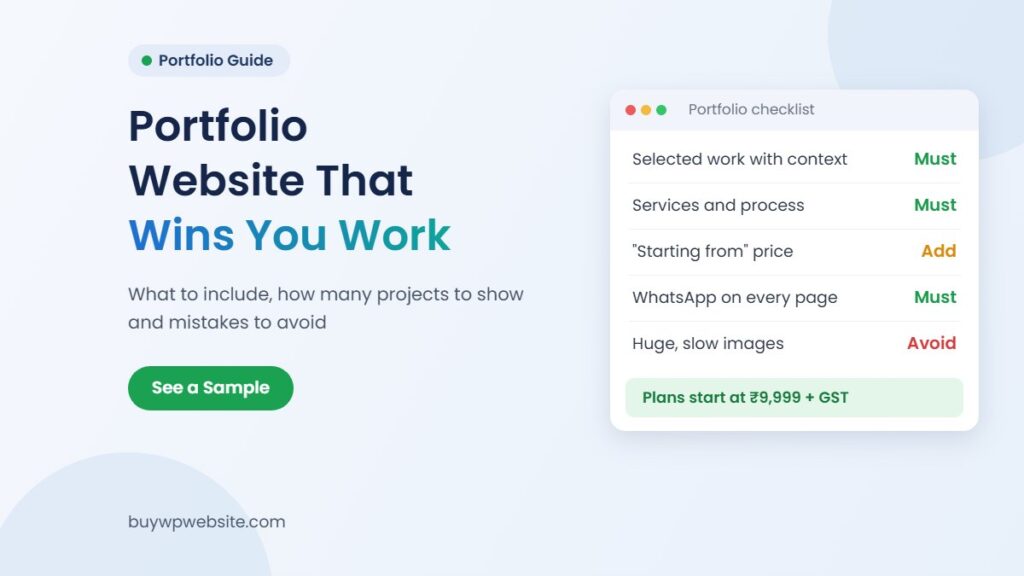
Quick answer: A portfolio website is your own site that shows your best work with context, the services you offer, who you are, how you work and how to contact you. It wins work because a client can judge you in two minutes without scrolling a feed. Show 6 to 12 strong projects, add a “starting from” price and a WhatsApp button, and put it on a domain with your name.
Why a portfolio website beats Instagram or Behance alone
Instagram and Behance are good places to be seen. Instagram helps people discover you and keeps past clients in touch. Behance puts your work in front of other designers and some buyers. Keep both if they bring you work.
The problem is what happens when a serious client wants to hire you. On a feed, your best wedding shoot sits between a meme reel and an old test shot. There is no clear list of services, no price idea and no simple way to send a brief. The client has to work hard to understand you, and many simply move to the next name.
A portfolio website fixes this. You decide the order, the story and the next step. It can show up when someone searches your name, it looks the same on every phone, and it does not change when an app changes its rules. We compared the two in detail in Instagram vs website for business. The short version: use social media to get attention, and your website to turn that attention into an enquiry.
What to include in a portfolio website
Most good portfolios use the same six building blocks. You can fit them into five pages, or even one long page with sections, if your work is focused.
Selected work, with context
Do not upload a folder of images. For each project, add a title, the client type or location, what the brief was, what you did and the outcome in plain words. Two or three lines are enough. A photo of a modular kitchen means more when the caption says “2BHK in Jaipur, small kitchen made to fit a family of five”.
Services
List what people can actually hire you for: pre-wedding shoots, bridal makeup, logo design, interior design for homes, tax consulting and so on. Clients search for a service, not for a person they have never heard of.
About
Add a real photo, your experience, training or qualifications and the cities you work in. Keep it human and short. People hire people they feel they can trust.
Process
Explain your steps in four or five lines: first call, quote, advance, work, review, delivery. This answers the worried client’s biggest question: what happens after I pay?
Pricing or “starting from”
You do not need a full rate card. A line like “Wedding packages starting from ₹X” filters out people who are not a fit and gives serious clients the confidence to message you.
Contact and WhatsApp
Put a WhatsApp button on every page, plus a short enquiry form, your phone number, email and the area you serve. Ask for the date, location and budget in the form so your first reply can be useful.
How many projects should a portfolio website show?
For most freelancers and small studios, 6 to 12 projects is the right range. Fewer than six can look thin. More than twelve on one page usually means the visitor sees your average work, not your best.
Some simple rules help:
- Lead with the work you want more of. If you want more corporate shoots, do not open with birthday parties.
- Group projects by category (weddings, products, interiors) so a client goes straight to what they need.
- Give your 3 or 4 strongest projects their own pages with more photos and a short story.
- Replace old work once a year. A portfolio is never finished.
- Only show work you have the right to show. Ask clients before you publish their photos, homes or brand work.
What each profession should show: a quick table
The six building blocks stay the same, but the proof changes by profession. Use this as a starting point.
| Profession | What to show | Helpful extra |
|---|---|---|
| Photographer | Full galleries per event or shoot type, not single best frames | Packages “starting from”, date-check form |
| Architect | Built projects with plans, site photos and the brief | Project type and city, design process |
| Interior designer | Before and after photos of rooms, budget range per project | Materials used, timeline per project |
| Graphic designer | Case studies: problem, concepts, final logo or brand kit | Industries served, turnaround time |
| Makeup artist | Bridal and party looks under natural light, with consent | Travel area, trial session details |
| Consultant | Types of problems solved, sample reports (anonymised) | Qualifications, engagement process |
| Advocate | Only the Bar Council Schedule items: name, contact details, enrolment details, qualifications, areas of practice | No work samples, case results, testimonials or fees |
| Freelance developer or writer | Live links or samples, with your exact role | Tools you use, how you bill |
Advocates are a special case: Rule 36 of the Bar Council of India Rules bans advertising and soliciting work. Its proviso allows only the website particulars listed in a BCI Schedule: name, contact details, enrolment details, qualifications and areas of practice. So the work samples, prices and client stories suggested above do not apply to advocates. Read our advocate website and Bar Council rules guide before you build one, and confirm the latest position with your State Bar Council.
Should a personal portfolio website use your own name as the domain?
Yes, in most cases. A personal portfolio website on yourname.com or yourname.in is easy to remember, easy to say on a call and easy to print on a visiting card. It also helps you appear when a client searches your name after a referral.
If you run a studio with a brand name, use the brand instead and keep the name consistent with your Instagram handle and Google Business Profile. Avoid hyphens, numbers and spellings people will get wrong. Pair the domain with an email on the same domain, which looks more professional than a Gmail address when you send quotes.
Portfolio website mistakes that cost you enquiries
Most portfolio sites that do not bring work fail for a handful of fixable reasons:
- Huge images that load slowly. Many visitors open your link on a phone, often on mobile data. Compress photos before upload.
- No context. Beautiful work with no brief or result looks like a mood board, not a hiring decision.
- Hidden contact options. If the WhatsApp button is only in the footer, many people never find it.
- No idea of price. Clients who cannot guess your range often assume you are too expensive and do not ask.
- Clever menus. Labels like “Explore” or “Stories” confuse people. Use Work, Services, About, Contact.
- Outdated work. A portfolio last updated three years ago tells clients you are not busy, or not current.
If your site already exists but enquiries are low, our guide on why a website is not generating leads walks through the full checklist. And if you need a fully custom design built from scratch, a custom WordPress web design is the other route to consider.
How BuyWPWebsite can help
Our portfolio website design plans are built for photographers, designers, architects, makeup artists, consultants and freelancers who want a clean, mobile-friendly site that brings enquiries. Each annual plan includes website design, hosting, domain, SSL and maintenance.
- Basic, ₹9,999 + GST: 5 pages, about 4 working days. Enough for most freelancers: Home, Work, Services, About, Contact.
- Standard, ₹14,999 + GST: 15 pages, about 7 working days. Good if you want separate pages for key projects or categories.
- Premium, ₹24,999 + GST: 40 pages, about 12 working days. For studios with many case studies or services.
Changes are free during the plan’s maintenance period. Not sure how it will look? Order a ₹999 + GST design preview of a gallery-style portfolio first, or message us on WhatsApp with a link to your Instagram or work samples. You can compare everything on the Portfolio plan page.
Frequently asked questions
What should I include in a portfolio website?
Include selected work with short context, a list of services, an About section with your photo and experience, your working process, a “starting from” price and clear contact options, including WhatsApp. These six parts answer what most clients want to know before they message you.
Do I need a portfolio website if I have Instagram?
Instagram is useful for discovery, but your feed mixes everything together and does not show services, prices or process clearly. A portfolio website gives clients one clean page to judge you and contact you. Most professionals do best with both.
How many projects should I put in my portfolio?
Six to twelve strong projects work for most freelancers. Show the kind of work you want more of, group it by category and give your top three or four projects their own detailed pages.
Is a portfolio website good for freelancers?
Yes. A portfolio website for freelancers works as a 24×7 introduction you can share in one link on WhatsApp, email or LinkedIn. It also shows you are serious about your work, which helps when you quote higher-value projects.
Should I show prices on my portfolio website?
A “starting from” price is usually enough. It sets expectations and filters out poor-fit enquiries without locking you into a fixed rate card. Advocates should not list fees, as fees are not part of the Bar Council’s approved website particulars. CAs, doctors and other regulated professionals should check their own rules first.
Can I build a personal portfolio website with my own name?
Yes. A domain with your name is easy to remember and helps when people search for you. Our portfolio plans include the domain along with design, hosting, SSL and maintenance.