Quick answer: To sell Kota Doria saree online as a weaver, you need three things: photos that show the khat checks and the handloom finish up close, product pages that prove your sarees are genuine handwoven pieces from the Kota region, and a store that takes payment and ships reliably. A small WooCommerce store with 10 to 30 well-photographed sarees, plus WhatsApp and Instagram, is a realistic start. Rajasthan ODOP support for e-commerce may cover part of the cost, subject to DIC approval.
Kota Doria is the ODOP product of Kota district, and it is woven in Kaithoon and other villages around Kota, with some weavers in Bundi and Baran. This guide is written for the weaver or small family business that wants to sell directly to buyers instead of only through traders. For the bigger picture, see our ODOP scheme guide.
Why selling Kota Doria saree online is harder than it looks
Search for “Kota Doria saree” on any marketplace and you will find thousands of listings, many at prices no handloom weaver can match. Studies of the craft have long pointed out that power-loom fabric, much of it made outside Rajasthan, is sold under the same name. A buyer scrolling on a phone cannot easily tell the difference.
That is the real problem your store has to solve. You are not just listing sarees; you are proving that yours are the real thing and explaining why they cost more. Everything below is about doing that clearly.
Prove it is genuine handloom
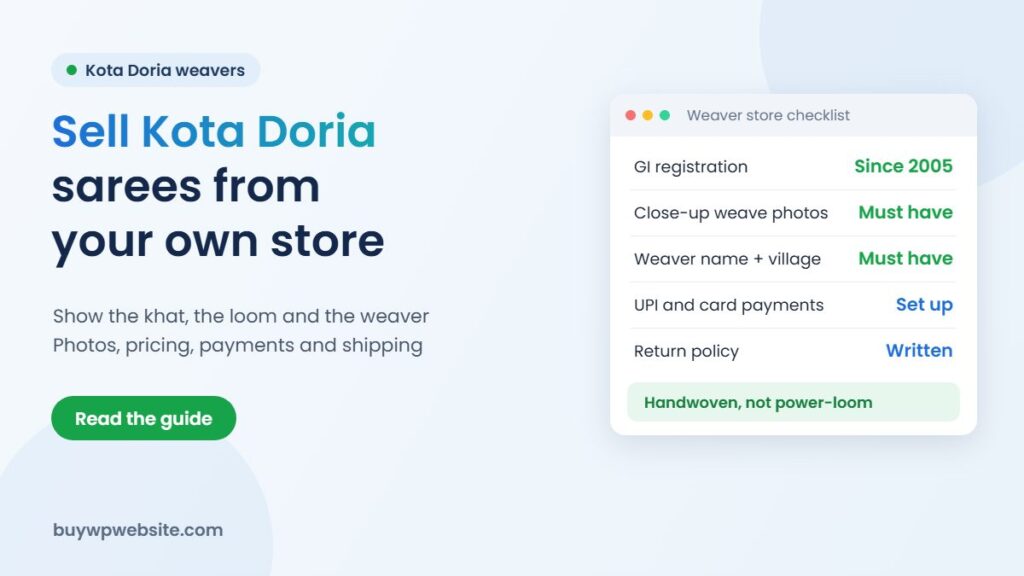
- GI status: Kota Doria received GI registration in 2005. If you are a registered authorised user, say so and show the certificate number on your About page. If you are not, do not use the GI logo; register first.
- Close-up photos: show the khat (the small square checks), the slight irregularities of hand weaving and the selvedge.
- Loom videos: a 20-second clip of your family at the loom is more convincing than any paragraph.
- Weaver’s name and village: put a real name and place on every product page.
- Handloom marks: if you hold any handloom certification or brand registration, show it plainly and accurately.
What a good Kota Doria product page includes
| Field | Example of what to write |
|---|---|
| Fabric | Cotton, cotton-silk, or silk; say which, honestly |
| Weave | Handwoven, with khat check size described |
| Border and pallu | Zari, thread work, or plain |
| Length | Total length and whether a blouse piece is included |
| Weight and feel | Light, sheer, crisp after starch, etc. |
| Care | Dry clean or gentle hand wash; starch advice |
| Dispatch time | Ready stock or made to order |
Write descriptions yourself. Copying text from other sellers makes your pages look identical to the power-loom listings you are trying to stand apart from.
Photographing sheer fabric
Kota Doria is light and see-through, which makes it tricky to photograph. A few habits help:
- Shoot in daylight near a window, never under yellow tube lights.
- Use a plain backdrop in a contrasting tone so the checks show; a white saree on a white wall disappears.
- Take five images per saree: full drape, pallu, border, close-up of the weave, and the fabric held against light.
- Keep colours true. A colour that looks different on screen is a common reason for saree returns.
Payments, shipping and returns for a small weaver
Payments
Offer UPI, cards and net banking through a payment gateway. Cash on delivery increases returns on sarees; if you offer it, consider limiting it to lower-priced pieces.
Shipping
Sarees are light and fold flat, so courier costs are manageable. Use a shipping aggregator that lets you compare couriers, and pack each saree in a cloth bag inside a waterproof cover and a sturdy box.
Returns
Write a short, clear policy: what can be returned, within how many days, and in what condition. Handwoven pieces have small irregularities; explain that this is a mark of hand weaving, not a defect.
Own store, marketplace or Instagram?
| Channel | Good for | Watch out for |
|---|---|---|
| Own online store | Telling the weaver’s story, repeat buyers, better margin | You must bring visitors yourself |
| Marketplaces | Reach and trust in checkout | Price competition with power-loom listings, commissions |
| Instagram and WhatsApp | Showing the loom, new designs, direct chats | Payments and order tracking get messy without a store |
Most weavers do best combining them: Instagram to show work, a store for checkout, and marketplaces later if they have stock to spare. Our guide to selling ODOP products online covers each channel in more depth, and this comparison of Shopify and WooCommerce explains platform choices.
Pricing handwoven sarees for online buyers
Work out your real cost per saree before setting a price: yarn, zari, days on the loom, starch and finishing, packaging, payment gateway charges, courier and an allowance for returns. Add your margin on top. Then show the price with confidence and explain what goes into it, for example how many days a piece took to weave. Avoid permanent “70% off” tags; they make a handloom saree look like a mass-produced one and train buyers to wait for discounts.
ODOP support a Kota Doria seller can ask about
Under clause 7.8 of the Rajasthan ODOP Policy 2024, an eligible MSME can claim a one-time 60% of its e-commerce website or cataloguing cost, up to ₹75,000, and 75% of marketplace fees up to ₹1 lakh a year for two years (shipping not covered). Fair support under clause 7.7 can help you take a stall at exhibitions. You need Udyam registration, and at least half your turnover must come from the ODOP product. Nothing is automatic: apply online with your SSO ID or through e-Mitra; the General Manager of DIC Kota approves claims. ODOP benefits for Kota Doria apply to units located in Kota district. Confirm current rules before you spend.
How we can help you set up
Our WooCommerce online store costs ₹25,000 + GST and includes 10 pages and 10 products (more from ₹300 each), with payments and shipping configured in about five days; hosting is bought separately. If you would rather start with a showcase site and take orders on WhatsApp, our business websites start at ₹9,999 + GST. Changes are made by our team: free during your plan’s maintenance period, and customisation after that is charged at ₹1,000 per hour. To grow Instagram and Facebook reach after launch, Webuncles runs social media campaigns.
District guide: ODOP of Kota: Kota Doria
ODOP technology partner
The scheme supports your business. We build the technology behind it.
From your first website to marketing and business software, one team handles the digital side of your ODOP business, so you can focus on making your product.
- Online store or business website
- Logo, packaging, label, brochure and flyer design
- Product cataloguing for your website and marketplaces
- SEO, Google Ads and Meta (Facebook & Instagram) Ads
- ERP, CRM, billing and finance software
Proper paperwork: a written quotation before we start and a GST invoice (bill) for the work we deliver — the documents your DIC usually asks for with a claim.
Chat on WhatsApp See website plans
More help: ODOP scheme guide · Rajasthan ODOP policy & subsidies · All ODOP guides
Please note: ODOP subsidies, grants and reimbursements are approved and paid only by the government, through your District Industries & Commerce Centre (DIC) or the scheme's official portal. BuyWPWebsite and Webuncles are private technology service providers, not a government office or agent. We cannot approve, guarantee, refund or reimburse any scheme amount, and our fees are for the work we deliver, payable as per our terms whether or not a claim is approved. Scheme rules change; please confirm the current rules with your DIC before you spend.
Frequently asked questions
How many sarees should I list when I start?
Start with what you can photograph well and ship quickly, often 10 to 30 pieces. A small, honest catalogue sells better than a large one with poor photos.
Can I use the Kota Doria GI logo on my website?
Only if you are a registered authorised user of the GI. Otherwise you can describe your sarees as handwoven in the Kota region, but should not use the logo.
Do I need GST to sell sarees online?
Most marketplaces ask for a GSTIN, and selling to other states usually needs GST registration. Some exemptions exist for small sellers, so ask your CA which rules apply to you before you launch.
How do I compete with cheaper power-loom sarees?
Do not compete on price. Show the loom, the weaver, the weave close-up and any GI or handloom credentials, and target buyers who specifically want handwoven work.
Sources: Rajasthan ODOP Policy 2024; CUTS case study on Kota Doria GI. Facts checked in November 2026.