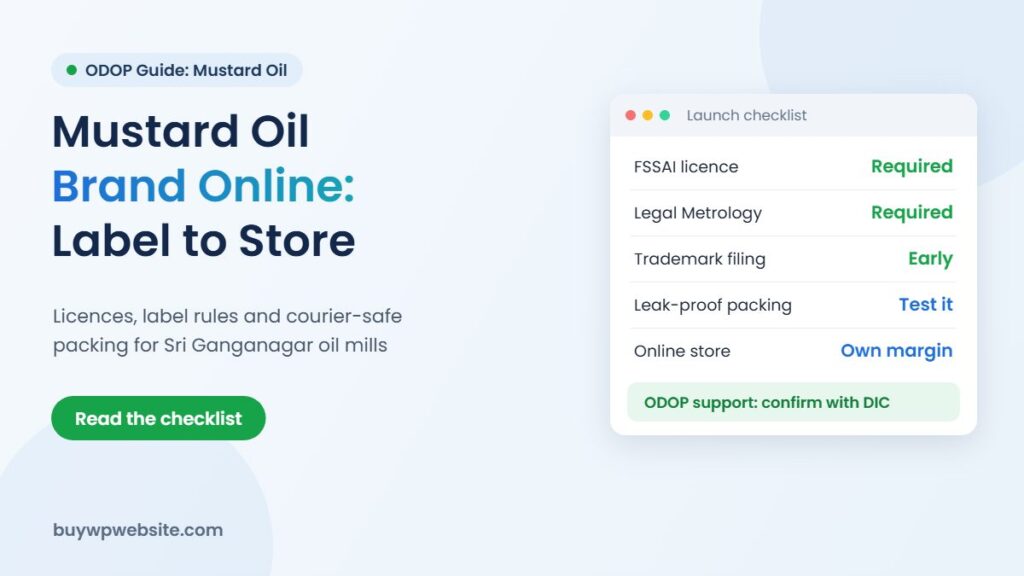
Quick answer: To sell a mustard oil brand online, you first need an FSSAI licence that covers edible oil, a label that carries every mandatory food and Legal Metrology declaration, and packaging that survives courier handling. After that, a simple online store plus a few marketplaces lets a Sri Ganganagar mill reach buyers far beyond the local mandi. This guide walks through the label rules, the online set-up and the ODOP support that may help, subject to approval by your DIC.
Sri Ganganagar’s notified product under the Rajasthan One District One Product policy is mustard oil. If you are new to the scheme, start with our complete guide to the ODOP scheme and come back here for the oil-specific details.
Why build a mustard oil brand online instead of selling only in bulk?
Many mills in the canal belt of north Rajasthan sell oil in tins to traders and keep the oil cake for cattle-feed buyers. That model works, but the trader sets the price and the mill’s name never reaches the kitchen. A branded bottle changes three things:
- You own the customer. Repeat buyers order again from your store or WhatsApp, not from whoever the wholesaler supplies next month.
- Origin becomes a selling point. Rajasthan is the country’s largest rapeseed-mustard growing state, and “pressed near the fields where the seed is grown” is a story city buyers respond to.
- Smaller packs, better margin. One-litre bottles and gift packs for festivals carry a price per litre that bulk tins never will.
The catch is that a retail pack is a regulated product. Get the compliance right before you spend a rupee on ads.
Licences you need before the first bottle is sold
- FSSAI registration or licence for manufacturing edible oil. The category depends on your production capacity and turnover; check it on the FoSCoS portal. Marketplaces will ask for this licence number before they list any food product.
- Legal Metrology registration as a packer of pre-packaged commodities, from the state Legal Metrology department.
- GST registration (needed for selling on most marketplaces and for inter-state supply) and Udyam registration, which is also the base for ODOP applications.
- A trademark application for your brand name and label, filed through IP India. Do this early; renaming a brand after printing lakhs of labels is painful.
What must a mustard oil label show?
Two sets of rules apply together: the FSS (Labelling and Display) Regulations, 2020 and the Legal Metrology (Packaged Commodities) Rules. In practice, your bottle or tin needs the following.
| Declaration | Comes from | Practical tip |
|---|---|---|
| Name of the food (for example, kachi ghani mustard oil) | FSSAI | Use a description only if your process and lab report match the FSSAI standard for that type |
| FSSAI logo and licence number | FSSAI | Must be clearly visible, not hidden in a fold |
| Veg (green dot) symbol | FSSAI | Place near the product name |
| Nutritional information | FSSAI | Base it on a test report from an accredited lab, not a copied table |
| Batch or lot number, date of manufacture or packing, best before | FSSAI and Legal Metrology | Print with an inkjet coder so every batch is traceable |
| Net quantity, MRP (inclusive of taxes), unit sale price | Legal Metrology | Oil is often declared by volume; check the unit your officer expects |
| Name and full address of manufacturer or packer, consumer care details | Legal Metrology | Give a phone number you actually answer |
Two oil-specific points deserve attention. First, FSSAI’s prohibition regulations bar multi-source edible oil containing mustard oil made on or after 8 June 2021, so a “mustard” pack must contain only mustard oil. Second, words like “pure”, “cold pressed” or “kachi ghani” are claims; FSSAI standards set test parameters for each type, and a misleading claim can attract action. Ask your food safety officer or a food technologist to review the final artwork before printing.
Packaging that survives courier delivery
Oil is one of the harder products to ship. A single leaking bottle can spoil a whole courier bag and earn you a one-star review. Mills that sell online well usually do the following:
- Use bottles with induction-sealed caps or tins with a sealed lid, then add a shrink band.
- Pack each bottle in a polybag before the carton, with a corrugated divider for multi-packs.
- Drop-test a sample parcel and send a few orders to friends in other states before launch.
- Keep heavy 5 and 15 litre packs for local or B2B delivery; offer 1 litre and 2 litre packs for courier orders.
Once packing is sorted, decide your sales channels. Our hub on selling ODOP products online compares marketplaces, your own store and B2B portals in detail.
Setting up a mustard oil brand online store
Marketplaces bring traffic, but they also bring commission, return rules and price wars. Your own store is where you keep full margin and build repeat customers. A useful store for an oil brand needs:
- Clear pack sizes and prices with GST shown properly on invoices.
- Pin-code based shipping so you can restrict heavy tins to nearby areas and charge fairly for distant ones.
- A “From our mill” page with real photos of the expeller, seed storage and your family or team, plus your FSSAI licence number.
- Lab report summary per batch if you make purity claims. This builds trust faster than any slogan.
- WhatsApp ordering for older customers and for shopkeepers who want to reorder in cartons.
Where else to list
Amazon and Flipkart grocery categories, ONDC through a seller app, and GeM if you want to supply government canteens or hostels. B2B portals help you find kirana distributors in Punjab, Haryana and Delhi, the markets closest to Sri Ganganagar. Each platform has its own documents, so prepare your FSSAI, GST and trademark papers in one folder.
ODOP support a mustard oil unit can apply for
Under the Rajasthan ODOP Policy 2024, an MSME that makes the district’s notified product and earns at least half its turnover from it may apply for support. The clauses most relevant to an oil mill are:
| Clause | Support | Use for an oil brand |
|---|---|---|
| 7.3 Certification | 75% up to ₹3 lakh, one time | FSSAI, ISO or ZED certification costs |
| 7.8 E-commerce website | 60% up to ₹75,000, one time | Online store and product cataloguing |
| 7.8 Marketplace fees | 75% up to ₹1 lakh a year for 2 years | Marketplace fees (not shipping) |
| 7.7 Fairs | Stall and travel support, limits per event | Food expos where distributors look for brands |
All support is subject to approval and the policy guidelines in force when you apply. Confirm eligibility and documents with the District Industries and Commerce Centre in Sri Ganganagar before you spend money expecting a refund.
How we help mustard oil brands go online
BuyWPWebsite builds a WooCommerce online store for ₹25,000 + GST with 10 pages, 10 products, payment gateway and shipping set up in about five days. If you only need a brand website for distributors, our business website plans start at ₹9,999 + GST. Our parent company Webuncles handles logo and label design for products and digital marketing once the store is live. We are a private technology provider, not a government office.
District guide: ODOP of Sri Ganganagar: Mustard Oil
ODOP technology partner
The scheme supports your business. We build the technology behind it.
From your first website to marketing and business software, one team handles the digital side of your ODOP business, so you can focus on making your product.
- Online store or business website
- Logo, packaging, label, brochure and flyer design
- Product cataloguing for your website and marketplaces
- SEO, Google Ads and Meta (Facebook & Instagram) Ads
- ERP, CRM, billing and finance software
Proper paperwork: a written quotation before we start and a GST invoice (bill) for the work we deliver — the documents your DIC usually asks for with a claim.
Chat on WhatsApp See website plans
More help: ODOP scheme guide · Rajasthan ODOP policy & subsidies · All ODOP guides
Please note: ODOP subsidies, grants and reimbursements are approved and paid only by the government, through your District Industries & Commerce Centre (DIC) or the scheme's official portal. BuyWPWebsite and Webuncles are private technology service providers, not a government office or agent. We cannot approve, guarantee, refund or reimburse any scheme amount, and our fees are for the work we deliver, payable as per our terms whether or not a claim is approved. Scheme rules change; please confirm the current rules with your DIC before you spend.
Frequently asked questions
Can I sell home-made or small-batch mustard oil online without FSSAI?
No. Every food business needs at least FSSAI registration, and marketplaces and payment gateways ask for the number. Small units usually start with basic registration; check the right category on FoSCoS.
Can I call my oil “kachi ghani” or “cold pressed”?
Only if your process and lab results meet the FSSAI standard for that description. Keep the test report on file and show a summary on your website.
Is it allowed to mix mustard oil with another oil to lower the price?
No. FSSAI has prohibited blending mustard oil with other edible oils. A pack sold as mustard oil must contain mustard oil only.
Will ODOP pay for my online store?
The policy allows one-time support of 60% up to ₹75,000 for an e-commerce website or cataloguing, but it is subject to approval. Confirm the process with your DIC before you start.
Sources: FSSAI (Labelling and Display) Regulations 2020, FSSAI order on mustard oil blending, Rajasthan ODOP Policy 2024. Rules change, so confirm with FSSAI, Legal Metrology and your DIC. Facts checked in November 2026.