Quick answer: Under One District One Product, Barmer’s notified product is kasheedakari, the hand embroidery done mostly by women in the district’s villages. The one district one product Barmer listing can support embroidery units and producer groups through the Rajasthan ODOP Policy 2024, subject to DIC approval. The biggest online opportunity is selling the story and skill behind each piece directly to buyers who value handmade work, rather than competing on price with machine embroidery.
For how the scheme works overall, start with our ODOP scheme guide.
One district one product Barmer: the kasheedakari craft
“Kasheeda” simply means embroidery, and in Barmer it covers several distinct styles practised by different communities in the Thar desert villages. The Ministry of Textiles’ handicrafts portal describes Meghwal embroidery in detail: women traditionally do the work, and after the 1971 India-Pakistan war, refugee families who settled in rural Barmer brought their stitching traditions with them.
The same source lists the techniques you will see in Barmer pieces:
- Ari: chain stitch made with a hooked needle, used for fine geometric patterns.
- Mukke ka kaam: a raised, padded effect.
- Kharek and pakko: dense, intricate designs, often with mirror work.
- Rabari-style work: bold patterns with appliqué and mirrors.
Motifs draw on desert life: peacocks, camels, elephants and parrots, flowers such as the lotus, and geometric shapes. Barmer is also known for katab, an appliqué patchwork, which is a related but separate craft.
Is there a GI tag for Barmer embroidery?
Not yet, as far as our checks of the IP India GI registry show. Several applications from western Rajasthan were filed in 2024 and are still under examination, including “Barmer Katab (Patch Work)” filed by Roshani Sansthan Barmer, and separate applications for Soof and Pakka/Pakko embroidery filed by the Urmul Rural Health Research and Development Trust. Until a GI is registered, do not label products “GI tagged”. If one of these is granted, registering as an authorised user could become a strong selling point.
Who buys Barmer embroidery
| Buyer | What they buy | What wins the order |
|---|---|---|
| Urban shoppers in India | Kurtas, dupattas, bags, cushion covers | Good photos, fair price, story of the maker |
| Fashion and home-decor labels | Embroidered panels, yardage, custom motifs | Consistent quality, sampling, deadlines met |
| Gift and corporate buyers | Pouches, stoles, wall hangings | Bulk capacity, branded packaging |
| Overseas buyers and boutiques | Traditional and contemporary pieces | Reliable communication, export paperwork |
| Government buyers | Gifting and décor through E-Bazaar or GeM | Empanelment as an ODOP MSME |
The common thread is that buyers pay more for authenticity they can verify. Hand embroidery takes days per piece; your selling has to make that visible.
ODOP support that fits embroidery units
All support is subject to eligibility and approval by the District Industries & Commerce Centre. Our Rajasthan ODOP Policy 2024 hub covers every clause.
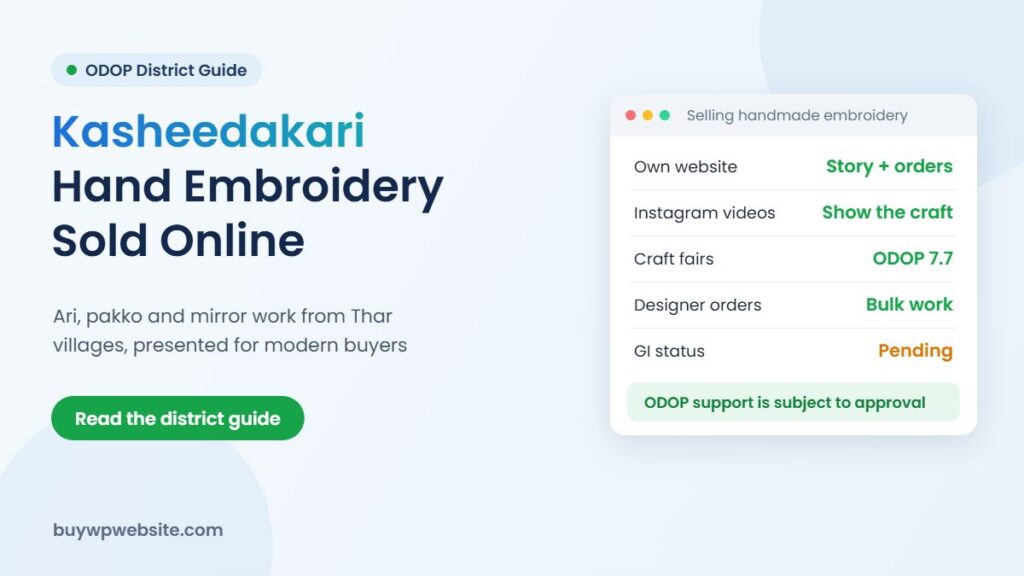
- Fairs and exhibitions (7.7): probably the most useful clause for crafts. Stall and travel support for fairs in Rajasthan (75%, up to ₹50,000 per event, three a year), elsewhere in India (up to ₹1.5 lakh per event, two a year) and abroad (up to ₹2 lakh, once a year).
- Extra support for women-led units in several clauses, relevant since most kasheeda work is done by women.
- Margin money (7.1) for setting up a workshop, finishing unit or stock.
- E-commerce (7.8): 75% of marketplace fees up to ₹1 lakh a year for two years, and one-time 60% support up to ₹75,000 for your own e-commerce website or cataloguing.
- Unity Mall, Jaipur and state department purchases from empanelled ODOP MSMEs.
Individual artisans can also ask the office of the Development Commissioner (Handicrafts) about the Pehchan artisan identity card, which is often asked for at craft fairs and under handicraft schemes.
Selling kasheedakari online
Your own website as the storefront
Handmade goods sell on trust and story, which marketplaces leave little room for. Your own site lets you show each artisan group, explain the stitch names, publish care instructions and take custom or bulk enquiries from designers. It also gives overseas buyers somewhere credible to check before they email you.
Marketplaces and social channels
- Amazon, Flipkart and ONDC-linked apps for ready products with fixed sizes, such as bags and cushion covers.
- Instagram and WhatsApp for one-of-a-kind pieces, where short videos of the stitching process do the selling.
- GeM and Rajasthan’s E-Bazaar for institutional gifting, once empanelled.
See our guide to selling ODOP products online for a side-by-side comparison.
Marketing ideas that suit hand embroidery
- Name the stitch: “ari work cushion cover” or “pakko mirror-work pouch” helps serious buyers find you and sets you apart from generic “Rajasthani embroidery”.
- Show the hours: a close-up video of a piece in progress explains the price better than any caption.
- Maker cards: a small tag with the artisan’s first name and village (with her consent) builds connection.
- Collections, not catalogues: launch small seasonal collections (Diwali gifting, wedding season) rather than listing everything at once.
- Collaborate with designers who want authentic hand embroidery for their own labels; it brings steady bulk work.
If you want help with paid promotion, Webuncles runs Facebook and Instagram advertising for small brands.
How BuyWPWebsite can help Barmer artisans
We are a private technology company, not a government body. For producer groups that mainly take orders and enquiries, a portfolio website (from ₹9,999 + GST) shows your collections, artisans and process beautifully. To sell directly with online payments, our WooCommerce online store (₹25,000 + GST, 10 products included) handles payments and shipping. Our team makes updates for you, so artisans do not need to manage the site.
Related guides: Kasheedakari Embroidery: Instagram and Online Store (Barmer)
ODOP technology partner
The scheme supports your business. We build the technology behind it.
From your first website to marketing and business software, one team handles the digital side of your ODOP business, so you can focus on making your product.
- Online store or business website
- Logo, packaging, label, brochure and flyer design
- Product cataloguing for your website and marketplaces
- SEO, Google Ads and Meta (Facebook & Instagram) Ads
- ERP, CRM, billing and finance software
Proper paperwork: a written quotation before we start and a GST invoice (bill) for the work we deliver — the documents your DIC usually asks for with a claim.
Chat on WhatsApp See website plans
More help: ODOP scheme guide · Rajasthan ODOP policy & subsidies · All ODOP guides
Please note: ODOP subsidies, grants and reimbursements are approved and paid only by the government, through your District Industries & Commerce Centre (DIC) or the scheme's official portal. BuyWPWebsite and Webuncles are private technology service providers, not a government office or agent. We cannot approve, guarantee, refund or reimburse any scheme amount, and our fees are for the work we deliver, payable as per our terms whether or not a claim is approved. Scheme rules change; please confirm the current rules with your DIC before you spend.
Frequently asked questions
Can a women’s self-help group apply for Barmer ODOP support?
The policy is written for MSMEs, so the group may need to register as an enterprise with Udyam registration. Ask the Barmer DIC which structure is accepted and which clauses give extra support to women-led units.
How should I price hand-embroidered products online?
Add up fabric, thread, mirrors, the artisan’s hours at a fair wage, finishing, packaging, platform fees and shipping, then add your margin. Underpricing hurts the artisans and makes buyers suspect the piece is machine-made.
Is Barmer embroidery the same as Balotra textiles?
No. Balotra is now a separate district with textiles as its own ODOP product. Barmer’s listing is specifically kasheedakari, the hand embroidery tradition.
Sources: Ministry of Textiles handicrafts portal (Meghwal embroidery), IP India GI registry, Rajasthan ODOP Policy 2024. Facts checked in November 2026.