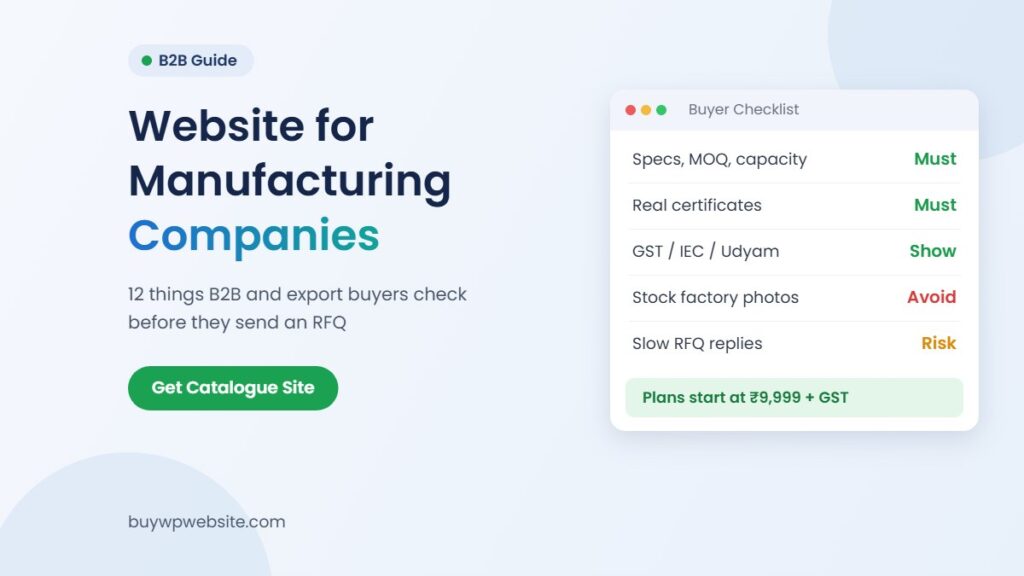
Quick answer: A good website for manufacturing company sales works like a catalogue and a sales engineer in one. It shows buyers what you make, your specifications, MOQ and capacity, and proof they can check, such as certificates, factory photos and GST or IEC details. It then makes it easy to send an RFQ or a WhatsApp message. Get those 12 basics right before you think about design extras.
This guide is for manufacturers in Rajasthan and across India: textile units, stone processors, auto parts makers, food processors and handicraft workshops. It covers what B2B and export buyers look for.
What should a manufacturing company website do?
A manufacturer’s website has three jobs. First, help a new buyer decide quickly whether you make what they need. Second, give them enough proof to trust a company they have never met. Third, turn that interest into an enquiry with the details you need to quote.
It is not a brochure about your history. Buyers usually shortlist several suppliers and skip sites that hide the basics. If you list on marketplaces, our comparison of IndiaMART vs your own website explains how the two work together. A marketplace helps buyers find you, while your website is where they check you.
12 things buyers look for on a manufacturer website
Here are the 12 points, grouped into three parts: what you make, why they should trust you, and how to reach you.
1. Product categories with clear specifications
Organise products the way buyers search: by category, then by product. Each product page should state size, material, grade, finish, tolerance or GSM, packing and any options. A stone unit might list thickness and finish for each slab type. A textile unit might list fabric, count, width and print options.
Avoid vague lines like “all types available”. Buyers want numbers they can compare with their requirement sheet.
2. MOQ and lead time
State your minimum order quantity and typical lead time per product or category. This filters out mismatched enquiries before they reach your phone. If MOQ depends on the design, say so and give a starting figure.
3. Production capacity and machinery
Mention monthly capacity in units, metres, tonnes or pieces, and list key machines or processes. Buyers placing repeat orders want to know you can scale. Only publish numbers you can actually deliver.
4. Certifications with real certificates
If you hold ISO, BIS or other certifications, show the certificate image with the number visible, not just the logo. ISO itself does not issue certificates; certification bodies do, and buyers can check accredited certificates through the tools listed in ISO’s guide to verifying a certification.
For BIS, buyers can check a licence (CM/L) number in the BIS Care app. Food processing units should show their FSSAI licence or registration number, since a food business needs one to operate. Never display a logo for a certification you do not hold.
5. Factory photos and a short video
Real photos of your unit, machines, quality check and packing area do more than any line of text. A short walk-through video shot on a good phone works well. Stock images are easy to spot and hurt trust.
6. GST, IEC and Udyam details
Put your GSTIN in the footer or on the About page. Anyone can look up a GSTIN through the Search Taxpayer option on the GST portal and see the legal name, status and principal place of business.
Exporters should mention their IEC, which DGFT says is mandatory for exports and imports unless specifically exempted. If you are registered on the Udyam portal, your Udyam number shows you are a registered MSME. The portal itself says registration is free, so do not pay an agent who claims otherwise.
7. Export markets and industries served
List the countries or regions you have shipped to and the industries you supply, but only real ones. A simple list of markets helps an importer see that you understand export packing, documents and timelines.
8. An enquiry or RFQ form that asks the right questions
A generic contact form gets you “price?” messages. Ask the buyer to mention the item, the quantity they need, any specs, where it must be delivered and how to reach them. You then have enough detail to quote in one reply.
9. A WhatsApp button with a pre-filled message
Many Indian buyers, and plenty of overseas ones, like to chat before they commit. Add a WhatsApp button on every product page with a message that names the product, so you know exactly what they were looking at.
10. A downloadable catalogue PDF
Purchase teams forward catalogues internally. Offer a PDF of your current range with specs and contact details, and update it whenever the range changes.
11. Contact details and a map
Show your full factory address, a Google Map, a landline or mobile number, and an email on your own domain. A Gmail address alone can make a large buyer hesitate.
12. A stated response time
Tell buyers when they will hear back, for example “we reply to RFQs within one working day”, and then keep that promise. Assign one person to check the website enquiries and WhatsApp every day. A slow reply undoes all the work above.
Manufacturer website examples by industry
The 12 points stay the same, but what you highlight changes with your product. Use this table as a starting point for your own pages:
| Industry | What to highlight | Proof buyers look for |
|---|---|---|
| Textiles (Kota Doria, Sanganeri, bedsheets) | Fabric, count, width, prints, MOQ per design | Swatch photos, process photos, GST |
| Marble and stone | Slab and tile sizes, thickness, finishes, quarry or processing unit | Container loading photos, IEC, export markets |
| Auto parts | Part numbers, materials, tolerances, vehicle fitment | ISO or IATF certificate, machine list, QC photos |
| Food processing | Product range, pack sizes, shelf life, private label options | FSSAI number, hygiene and packing photos |
| Handicrafts | Product range, materials, custom sizes, finish options | Artisan and workshop photos, export markets, ODOP link if applicable |
Stone exporters can go deeper with our marble and granite exporter website guide. Textile units that also want to sell retail can see how a Kota Doria online store is set up. If your product is your district’s ODOP product, read how to sell ODOP products online for marketplace and scheme links.
Website for manufacturing company: how many pages do you need?
Page count depends mostly on how many product categories you have. A simple structure is Home, About and factory, one page per product category, Certifications, Export markets, Catalogue download and Contact or RFQ.
| Your range | Suggested pages | Plan that fits |
|---|---|---|
| Up to 2 product categories | Home, About, 2 category pages, Contact | Basic (5 pages) |
| 3 to 8 categories, some key products | Home, About, Factory, Certifications, category and product pages, RFQ | Standard (15 pages) |
| Large range or export focus | All of the above plus individual product pages and market pages | Premium (40 pages) |
Most manufacturers with a real catalogue are better served by the Standard or Premium business website plan. Basic suits a unit with a narrow range that mainly needs an online address buyers can verify.
A website on its own does not bring traffic. Showing up when someone searches “manufacturer in Rajasthan” or a product and city name needs regular SEO work, and sometimes Google Ads. Once your site is live, our sister agency offers SEO and Google Ads support from Webuncles.
How BuyWPWebsite can help
The page structure above maps onto our business website plans for manufacturers and exporters. A narrow range fits Basic: 5 pages for ₹9,999 + GST, in about 4 working days. A wider catalogue suits Standard (15 pages, ₹14,999 + GST, about 7 working days) or Premium (40 pages, ₹24,999 + GST, about 12 working days). Extra pages cost ₹1,500 each on Basic and ₹1,200 on Standard or Premium.
Design, hosting, domain, SSL and maintenance come bundled in one yearly plan, and changes cost nothing extra while maintenance is active. Each site includes a standard enquiry form and a WhatsApp button so buyers can contact you directly. You share product details, certificates and factory photos.
To see the design before you commit, order a ₹999 + GST design preview. You can also ask on WhatsApp about a catalogue website for your factory, or read what each plan includes on the Business website product page.
Frequently asked questions
Why does a manufacturing company need a website?
Bulk and export buyers usually check a supplier online before they place an order. A website shows your products, specs, certificates and factory in one place, and gives buyers a direct way to send an enquiry that only you receive.
What should a manufacturing website include?
At minimum: product categories with specifications, MOQ and lead time, capacity, real certificates, factory photos, GST and IEC details, export markets, an enquiry or RFQ form, WhatsApp, a catalogue PDF, full contact details and a stated response time.
How much does a website for a manufacturing company cost?
With BuyWPWebsite, plans start at ₹9,999 + GST for 5 pages. Most manufacturers with a catalogue choose Standard (₹14,999 + GST) or Premium (₹24,999 + GST). Our website cost in India guide explains what drives the price elsewhere.
Should I show prices on my manufacturer website?
Many B2B manufacturers do not, because prices depend on quantity, specs and freight. Show MOQ and specifications instead, and ask buyers to send an RFQ for a quote.
Is a website better than an IndiaMART listing for manufacturers?
They do different jobs. A marketplace listing puts you in front of buyers searching for a product, while your own site is where they confirm you are genuine and reach you without a middleman. Running both, with the website address on your listing, covers discovery and trust.
How can buyers verify my certificates and registrations?
Buyers can look up a GSTIN on the GST portal, check accredited ISO certificates through the certification body or IAF CertSearch, and verify a BIS licence number in the BIS Care app. Showing clear certificate numbers makes this easy. Confirm current rules with your CA or certification body.